
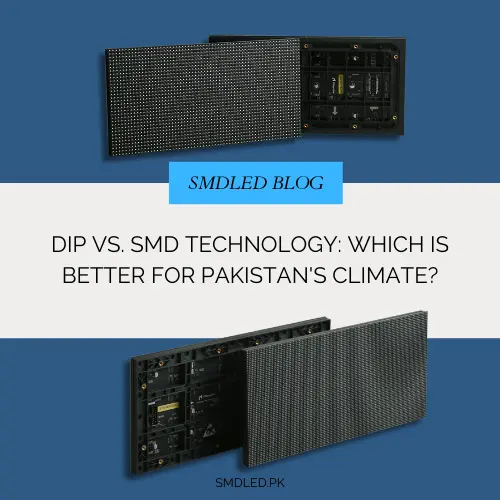
DIP vs. SMD Technology: Which Is Better for Pakistan’s Climate?
Choosing between DIP vs SMD technology is one of the most important decisions when investing in LED screens in Pakistan. The country’s climate presents extreme challenges including high temperatures, dust, humidity, monsoon rains, and prolonged sunlight exposure. Not all LED technologies perform equally under these conditions.
This article provides a complete, practical comparison of DIP vs SMD technology, focusing specifically on performance, durability, cost efficiency, and long-term reliability in Pakistan’s climate.
Understanding DIP and SMD Technology
To properly compare DIP vs SMD technology, it is essential to understand how each works.
What Is DIP Technology
DIP stands for Dual In-Line Package. In DIP LED screens, red, green, and blue LEDs are packaged separately and mounted through holes on the PCB.
What Is SMD Technology
SMD stands for Surface Mounted Device. In SMD screens, all three colors are combined into a single compact LED chip mounted directly onto the PCB.
This structural difference defines most performance characteristics in DIP vs SMD technology.
Brightness Performance in Sunlight
Brightness is a major factor when comparing DIP vs SMD technology for outdoor use.
DIP Brightness
• Extremely high brightness
• Historically used for large outdoor billboards
• Visible from very long distances
SMD Brightness
• Modern SMD screens now exceed 6000 nits
• Adjustable brightness levels
• Better color consistency
While DIP once dominated brightness, modern SMD has closed the gap significantly.
Explore outdoor SMD solutions
https://smdled.pk/products/bia-outdoor-smd-screen-module/
Durability in Pakistan’s Climate
Durability is where DIP vs SMD technology becomes especially relevant in Pakistan.
DIP Durability
• Strong physical structure
• Good resistance to heat
• Limited protection against moisture
SMD Durability
• Fully sealed LED packages
• Better moisture resistance
• Advanced heat dissipation
In dusty and humid environments, SMD technology now performs more reliably.
Viewing Angle and Image Quality
Another major difference in DIP vs SMD technology is image quality.
DIP Viewing Angle
• Narrower viewing angles
• Color distortion at side angles
SMD Viewing Angle
• Wide viewing angles up to 160 degrees
• Uniform brightness and color
For urban environments where viewers approach from multiple angles, SMD has a clear advantage.
Resolution and Pixel Pitch Options
Resolution flexibility is a key consideration in DIP vs SMD technology.
DIP Resolution
• Limited pixel pitch options
• Mostly used in P10 and above
SMD Resolution
• Available from ultra-fine pitch to large pitch
• Supports HD and 4K video walls
High-resolution solutions are available here
https://smdled.pk/products/bia-hdr-4k-led-video-wall/
Power Consumption and Efficiency
Power usage is a critical cost factor when evaluating DIP vs SMD technology.
DIP Power Consumption
• Higher power usage
• Less energy efficient
• Higher operating cost
SMD Power Consumption
• Lower power consumption
• Better efficiency per brightness unit
• Reduced electricity bills
For long-term outdoor installations, SMD is more cost effective.
Maintenance and Long-Term Reliability
Maintenance needs differ significantly in DIP vs SMD technology.
DIP Maintenance
• Individual LED replacement
• More frequent servicing
• Higher downtime
SMD Maintenance
• Modular replacement
• Faster repairs
• Lower long-term maintenance cost
In Pakistan’s climate, lower maintenance translates directly into higher ROI.
Cost Comparison
Initial cost and lifecycle cost are both important in DIP vs SMD technology.
DIP Cost
• Lower initial cost
• Higher maintenance and power cost
SMD Cost
• Slightly higher upfront cost
• Lower operational expenses
• Longer lifespan
Most modern buyers prefer SMD for long-term installations.
Applications in Pakistan
Understanding DIP vs SMD technology becomes clearer when looking at real applications.
DIP is still used in
• Very large highway billboards
• Long-distance signage
SMD dominates in
• Urban billboards
• Commercial displays
• Events and rentals
• Video walls
Browse available SMD solutions
https://smdled.pk/products/
Why SMD Is Becoming the Standard in Pakistan
Across major cities, DIP vs SMD technology trends clearly favor SMD because of
• Better image quality
• Energy efficiency
• Climate resistance
• Lower total cost of ownership
This is why most new installations now use SMD technology.
Choosing the Right Technology for Your Project
When deciding between DIP vs SMD technology, consider
• Installation location
• Viewing distance
• Power availability
• Maintenance capability
• Budget
Professional consultation ensures the right decision.
Get expert advice
https://smdled.pk/contact-us/
Industry updates and installations
https://www.facebook.com/Pksmdled
FAQs – DIP vs SMD Technology
1. Which is better DIP or SMD for Pakistan
SMD is generally better due to efficiency and climate resistance.
2. Is DIP technology outdated
DIP is still used but is being replaced by modern SMD screens.
3. Which technology consumes less power
SMD technology consumes less power.
4. Which has better image quality
SMD offers better resolution and viewing angles.
5. Is SMD suitable for outdoor use
Yes modern SMD screens perform very well outdoors.
Call to Action
Understanding DIP vs SMD technology helps you choose a screen that performs reliably in Pakistan’s challenging climate. For most modern applications, SMD technology delivers superior performance, efficiency, and long-term value.
Explore SMD screen solutions
https://smdled.pk/
View available products
https://smdled.pk/products/
Get expert consultation
https://smdled.pk/contact-us/
Follow industry installations
https://www.facebook.com/Pksmdled