 Outdoor SMD Screens
 Indoor SMD Screens
 Flexible SMD Screens

The Science of “Grayscale” in SMD LED Screens
Grayscale describes how many brightness steps an LED screen can produce per colour. This guide explains bit depth, the difference…
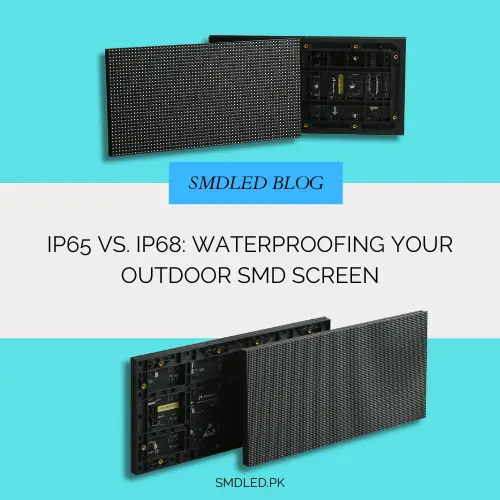
When businesses in Pakistan invest in outdoor digital advertising, they face real environmental challenges. A commercial LED display is a grid of electronics, and electronics do not mix well with monsoon rain and blowing dust. To protect them, manufacturers design outdoor screens with waterproofing and dust sealing.
Waterproofing is not a single generic feature. It is described using IP (Ingress Protection) ratings defined by an international standard. When you buy SMD screens in Pakistan, two ratings you will often see for outdoor products are IP65 and IP68.
Understanding the difference between these ratings, and what they do and do not mean, helps you choose a screen that suits its location and lasts longer.
In this guide we explain the IP rating system, how waterproofing is typically applied to LED modules and cabinets, the balance between sealing and heat dissipation, and how to decide whether IP65 is enough or IP68 is worth considering.
The Ingress Protection (IP) code, published by the International Electrotechnical Commission (IEC 60529), classifies the protection an enclosure provides against solid objects, dust and water.
An IP rating consists of the letters “IP” followed by two digits. Each digit describes a different type of protection.
The first digit indicates protection against solid objects, from hands and fingers down to dust. The scale runs from 0 (no protection) to 6 (dust-tight).
In both IP65 and IP68 the first digit is 6, meaning the enclosure is “dust-tight” under the test conditions of the standard. For outdoor displays in dusty urban environments, a dust-tight front is strongly recommended.
The second digit indicates protection against harmful ingress of water. The scale runs from 0 (no protection) up to 8 for immersion, with an additional 9K level (defined in a separate standard) for close-range high-pressure, high-temperature spray.
This second digit is where IP65 and IP68 differ. Note that the levels are different tests, not simply “more” of the same thing: a product rated for immersion (7 or 8) is not automatically tested against water jets (5 or 6) unless it is dual-rated, for example “IP65/IP68”.
IP65 is a widely used rating for outdoor LED display fronts. Products such as the BIA Outdoor SMD Screen Module are designed for outdoor use; always check the product datasheet for the exact front and rear ratings of the model you are buying.
What does IP65 mean in practice?
For the “5” water level, the enclosure is sprayed with water from a 6.3 mm nozzle from all practicable directions, at about 12.5 litres per minute and about 30 kPa from roughly 3 metres, for at least 3 minutes. Water must not enter in harmful quantities.
In practical terms, IP65 means the enclosure is dust-tight and protected against low-pressure water jets from any direction. For a properly installed outdoor billboard, this is generally suitable for rain, including heavy monsoon rain, as long as the whole installation (cabinets, cable entries, structure and drainage) is designed and installed correctly. It is not protection against powerful jets (that is IP66) or against immersion.
For most outdoor advertising installations, an IP65 front with a suitable rear rating is a sensible choice, without the extra cost of immersion-level protection.
While IP65 covers water jets, IP68 covers continuous immersion.
For IP68, the depth and duration of immersion are not fixed by the standard. They are agreed and stated by the manufacturer, and must be more severe than IP67 (which is immersion up to 1 metre for 30 minutes). Always check the manufacturer’s stated depth, duration and test conditions for the specific product.
An IP68 rating means the enclosure has passed an immersion test under the manufacturer’s stated conditions. It is a measure of how well water is kept out of an enclosure during a test; it does not mean an LED screen is designed to be operated underwater or that it is safe to keep a powered screen in flood water. If a screen is ever flooded or submerged, switch off the power at a safe point and have it inspected by a qualified technician before use.
Achieving IP68 on LED products usually involves more thorough sealing of components, for example heavier potting, more robust gaskets and sealed connectors. The exact construction varies by manufacturer.
This leads to a practical question: does your installation actually face immersion?
For most billboards and building-mounted screens the answer is no, and paying a premium for IP68 is usually unnecessary. IP68-rated modules or components may be relevant for special cases, such as some ground-level or floor-mounted installations exposed to standing water, but even then the manufacturer should confirm the product is suitable for that use.
It is useful to understand how manufacturers typically achieve waterproofing, so you can ask the right questions when comparing products.
Good waterproofing is not just a cover over the screen. It usually combines several layers of protection built into the SMD LED products.
At the circuit board level, many outdoor modules use a conformal coating: a thin protective layer sprayed or applied over the printed circuit board (PCB) to help protect components and solder joints from moisture.
Many outdoor modules also use “potting”, where silicone or resin is applied around the base of the LEDs on the front of the module. Once cured, it forms a barrier that helps keep moisture away from the electrical contacts.
The joints between modules and the cabinet are another potential entry point for water. Outdoor cabinets typically use rubber gaskets compressed between the module and the cabinet frame. When fitted and tightened correctly, the gasket forms a seal that helps keep rain out of the cabinet.
Water can travel along cables into connection points. Outdoor cabinets therefore commonly use sealed, locking connectors with rubber O-rings, along with sealed cable glands. Installers should also use drip loops and route cables so water runs away from connectors.
A key design challenge for outdoor LED screens is that sealing a cabinet against water also makes it harder for heat to escape.
LEDs and power supplies produce heat. Indoors, for example in a boardroom using a BIA Indoor SMD Screen Module, heat is relatively easy to manage with open ventilation.
Outdoors, open vents would let in rain and dust, so cabinets need a different approach.
If heat is not managed properly in a sealed cabinet, internal temperatures rise. This can affect colour, brightness and the lifespan of LEDs and power supplies.
Manufacturers use different approaches depending on the product. Some outdoor cabinets are designed to be fanless and use the aluminium casing as a heat sink, sometimes with fins on the rear. Others use fans or ventilation designed with protected airflow paths, or rely on the enclosure or building structure to provide cooling. Some installations also need external air conditioning or ventilation in the structure.
When comparing products, ask the supplier about the cabinet’s cooling method, its rated operating temperature range, and whether it suits your site’s temperatures. A cabinet that is well sealed but poorly cooled can suffer in hot weather, so look at both the IP rating and the thermal design.
When planning your budget, match your waterproofing requirements to the real conditions at the site. Over-specifying can use money that might be better spent on a suitable pixel pitch or screen size.
Because IP65 is common for outdoor display fronts, it is widely available across many price points. With correct installation and maintenance, an IP65 outdoor screen is generally suitable for Pakistan’s rain and dust, but long-term performance still depends on build quality, installation and maintenance.
IP68 products usually require more extensive sealing, more specialised materials and connectors, and careful thermal design, which typically adds cost.
Unless your site genuinely involves immersion risk, IP68 usually does not provide enough benefit to justify the extra cost.
Good waterproofing does not remove the need for maintenance. Seals and connectors should be inspected periodically. Inspection and maintenance work should be carried out by trained technicians, following the manufacturer’s instructions, with the power safely isolated and with suitable equipment and precautions for working at height.
Over years of heat and sun exposure, rubber gaskets can dry out, crack or lose elasticity. A failed seal can allow water into the cabinet. During scheduled maintenance, technicians should check seals and replace worn parts with manufacturer-approved replacements.
Sealed connectors can loosen over time due to vibration or wind. Checking that connectors and cable glands are properly fastened and undamaged is part of routine maintenance. This should only be done with the power isolated by a qualified person.
Improper cleaning can damage a screen’s seals. IP65 covers low-pressure water jets in a test; it does not cover high-pressure washers, which can force water past seals and damage modules. Clean the screen only using the method the manufacturer recommends, with the screen switched off, and have cleaning at height done by trained personnel.
Specification sheets often list separate ratings for the front and the rear of a screen (for example, Front IP65 / Rear IP54).
This is common practice, but it matters where and how the screen is installed.
If the screen is mounted where the rear is exposed to the weather, such as a standalone pole-mounted or double-sided structure, choose cabinets rated by the manufacturer for outdoor exposure on both sides, such as IP65 front and rear.
The lifespan of an outdoor screen depends heavily on how well it is protected from water and dust, and on how it is installed and maintained. Ignoring site conditions increases the risk of faults.
Understanding the IP rating system helps you make a better buying decision. For most outdoor advertising applications, a well-built screen with an IP65 front, a rear rating suited to the installation, and good thermal design offers a sensible balance of weather resistance and cost. IP68 is mainly relevant where immersion is a real possibility.
Check the datasheet ratings, ask about cooling and installation, and plan regular maintenance with qualified technicians.
IP65 means the enclosure is dust-tight and protected against low-pressure water jets from any direction, which suits most rain exposure when installed correctly. IP68 means the enclosure passed an immersion test under conditions stated by the manufacturer. It does not mean a screen is designed to be operated underwater.
For most outdoor billboards and retail displays, IP68 is not necessary. A well-built screen with an IP65 front and a rear rating suited to the installation is usually appropriate for rain. Check the datasheet and confirm suitability for your site with the supplier.
Waterproofing typically combines several measures: rubber gaskets between modules and cabinets, sealed cabinet seams, sealed locking connectors and cable glands, and conformal coating or potting on the circuit boards and around the LEDs. The exact construction varies by manufacturer.
It can if the cabinet is poorly designed for heat. Sealed cabinets need a suitable cooling method, such as heat-sinking through the casing or protected ventilation. Ask the supplier for the operating temperature range and cooling design, and check they suit your site.
Water entering the cabinet can cause short circuits, failed LEDs and corrosion. If you suspect water has entered the screen, switch off the power at a safe point and have a qualified technician inspect it before switching back on.
Protecting your investment starts with choosing hardware rated for your site and having it installed and maintained properly. At SMD LED we supply outdoor displays and can help you compare IP ratings, cooling design and installation options for your location.
Explore our products on the main SMD LED website, or contact our team through our Contact Us page to discuss your project. You can also follow us on Facebook for updates.
Grayscale describes how many brightness steps an LED screen can produce per colour. This guide explains bit depth, the difference…
If your SMD LED display is the body, the control system is the brain. Choosing the wrong control system can…
Pixel pitch is often misunderstood. Learn what it really means, how it relates to resolution, viewing distance, indoor vs outdoor…