
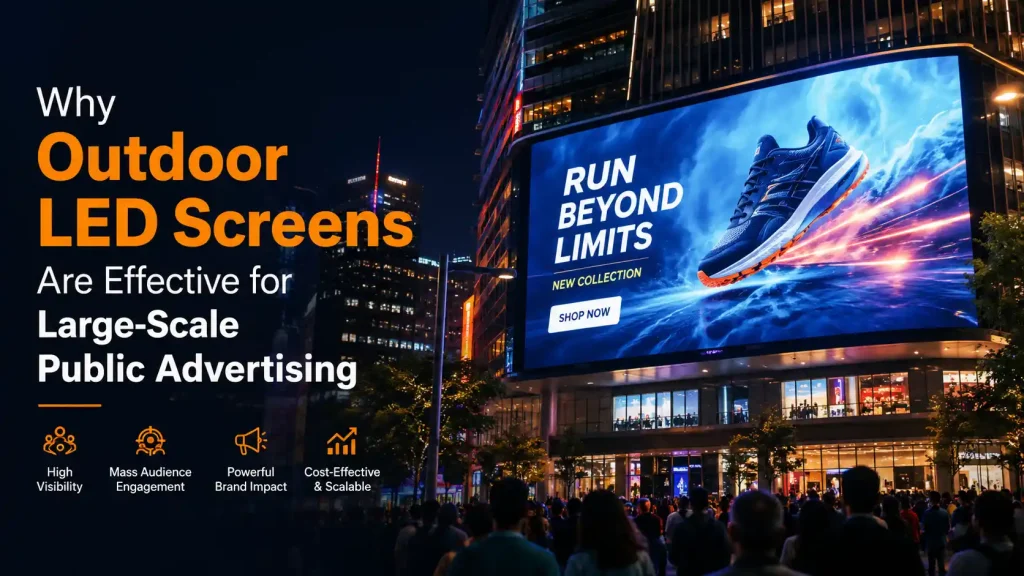
Imagine a brand launching a major campaign in the middle of a busy commercial district. Thousands of people pass through the area every day, but most are moving quickly. Drivers are watching the road, pedestrians are focused on their destinations, and surrounding buildings are already covered with signs and advertisements.
In an environment like this, simply placing a larger poster on a wall does not guarantee attention.
Outdoor LED screens give advertisers a way to combine scale, movement, brightness, and frequently changing content in one highly visible medium. When positioned correctly, these displays can turn busy roads, commercial buildings, transit areas, and public venues into active advertising platforms.
The Real Test: Can People See the Message?
Outdoor advertising has a basic challenge that indoor advertising does not face: distance.
A person standing several meters away needs to understand the message without stopping in front of the display. A driver may only have a few seconds to notice a campaign. A large crowd may approach from different directions and viewing angles.
This makes visibility a central part of outdoor LED screen planning.
The display needs to be large enough for the environment, bright enough for the surrounding conditions, and configured so that important visual information remains recognizable from the expected viewing distance.
That is why an outdoor screen designed for a highway should not necessarily be designed in exactly the same way as one positioned outside a shopping center.
Different Locations Create Different Advertising Opportunities
The same display technology can serve very different purposes depending on where it is installed.
Busy Intersections
Traffic signals naturally create periods when drivers and passengers remain in one area for several moments. A well-positioned screen can use that opportunity for short promotional messages, branding, or time-sensitive offers.
Shopping Districts
In pedestrian-heavy commercial areas, displays can sit closer to the audience and support retail promotions, product launches, or nearby store campaigns.
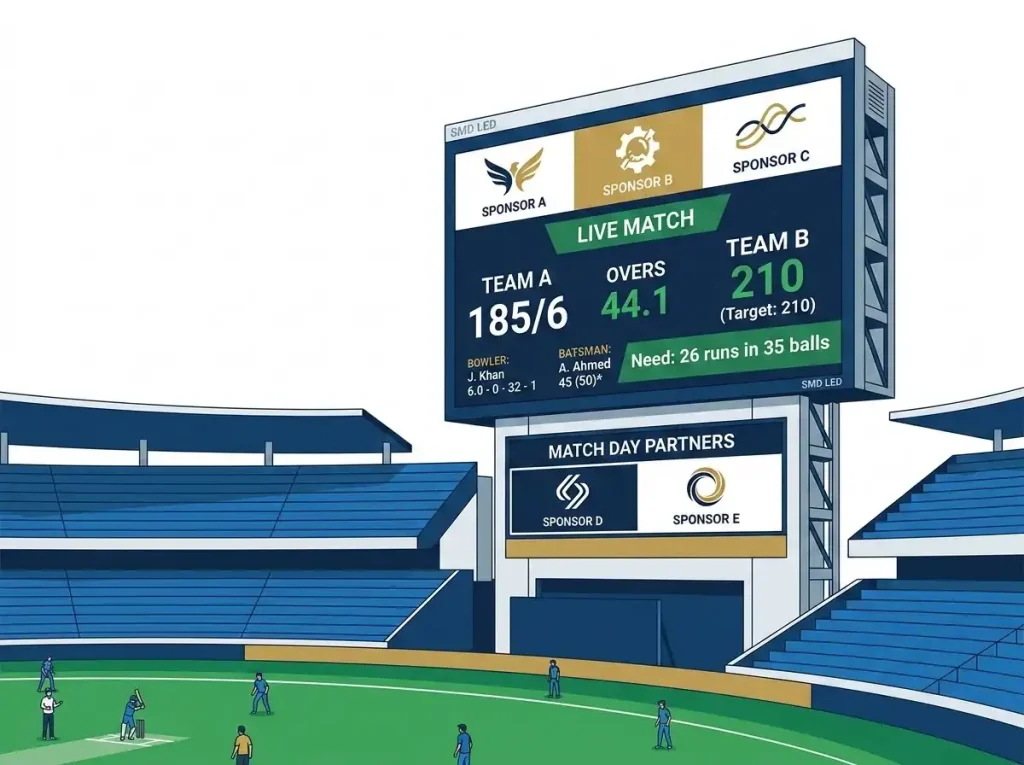
Stadiums and Event Venues
Large public gatherings create concentrated audiences. LED displays can carry advertising, sponsorship content, event information, and branded visual material across large viewing areas.
Transit Locations
Transport terminals and other high-footfall locations can support repeated advertising loops because people arrive, wait, and move through the space throughout the day.
Building Facades
Large commercial buildings can provide the physical scale required for high-impact LED advertising while turning otherwise unused exterior surfaces into communication spaces.
The important point is that location should influence the display design, rather than choosing a screen first and finding a place for it afterward.
Outdoor Conditions Change the Hardware Requirements
An outdoor display has to deal with far more than an advertising message.
Direct sunlight can reduce perceived contrast. Dust can accumulate on equipment. Rain introduces moisture concerns, while prolonged heat can increase the operating demands placed on electronic components.
For this reason, outdoor LED systems need construction and protection suited to their environment.
Depending on the installation, planning may include:
- Weather-resistant cabinet construction
- Appropriate protection against dust and moisture
- Cooling and heat-management considerations
- Structural support for large installations
- Brightness levels suitable for daylight viewing
- Installation methods appropriate for exposed locations
The exact requirements depend on the site, local conditions, and the selected LED system.
Why Moving Content Changes the Advertising Experience
A printed billboard remains visually unchanged until someone replaces it. An LED display can present a sequence of different messages from the same physical location.
This means an advertiser could use one screen to promote:
Morning: a breakfast or early-shopping promotion Afternoon: a retail offer or product campaign Evening: an event announcement or special promotion
The schedule can also be changed when a campaign ends, allowing businesses to update content without removing physical signage.
For advertisers managing multiple campaigns, this turns the display into reusable digital advertising space rather than a one-message installation.
Designing for the People Passing By
More content is not necessarily better content.
Outdoor audiences often have limited time to process an advertisement, particularly when they are driving or walking through a crowded area. Messages therefore need to be easy to recognize at the intended distance.
Large headlines, recognizable branding, strong imagery, and concise promotional information can be easier to process than an advertisement filled with small text.
The screen’s technical configuration should support the content rather than dictate it.
For example, a display viewed from a long distance may require a different pixel pitch from one positioned near pedestrians. Similarly, a large highway billboard has different content requirements from a screen installed at a shopping plaza entrance.
Choosing the Right Specifications for the Site
Once the location and audience have been understood, technical specifications can be selected more intelligently.
Pixel Pitch
Pixel pitch affects image detail and should be considered alongside viewing distance. Displays intended for audiences farther away can use different pitch configurations from screens viewed at close range.
Brightness
Outdoor displays need sufficient brightness to remain visible under daylight conditions. The appropriate level depends on the site’s exposure and surrounding lighting.
Screen Size
The physical scale of the display should reflect the viewing distance, available installation area, and visual purpose.
Refresh Rate
A suitable refresh rate helps the display present video content smoothly and can reduce visible scanning or flickering effects in situations where cameras are used.
Power and Cooling
Large outdoor displays require appropriate power distribution and thermal management for reliable operation.
Choosing these specifications around the actual site is more useful than selecting hardware based purely on headline numbers.
The Installation Is Part of the Advertising Strategy
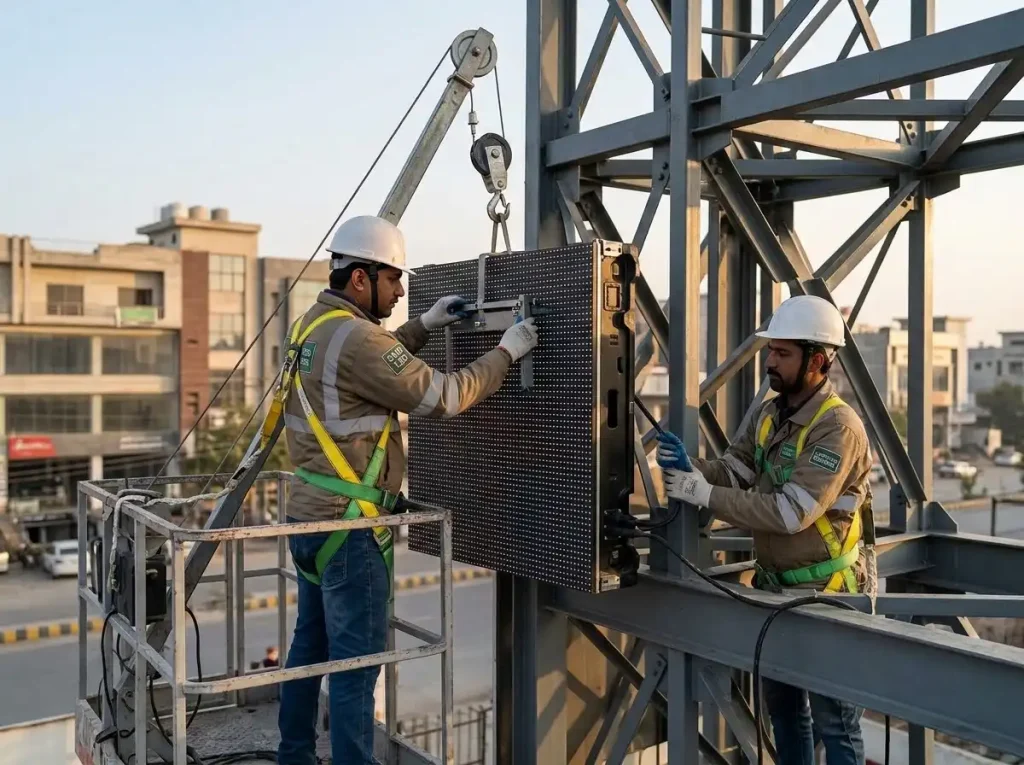
A large outdoor LED screen is not simply placed on a wall and switched on.
The installation may require structural assessment, mounting design, electrical planning, cable management, service access, and consideration of local requirements. High-mounted displays also require appropriate rigging and installation procedures.
Before deployment, businesses should establish:
- Exact screen dimensions and mounting location
- Expected viewing distances and angles
- Daylight exposure and brightness requirements
- Structural and wind-load considerations
- Electrical and power requirements
- Content-management arrangements
- Maintenance and service access
- Applicable local permissions or site requirements
Good preparation protects both the equipment and the advertising investment.
Making a Large Public Display Work Harder
An outdoor LED screen can become much more than a giant version of a printed billboard. Its ability to display motion, rotate multiple campaigns, and update content gives advertisers greater flexibility over how they use valuable public-facing space.
But visibility does not come from size alone.
The strongest installations bring together the right location, suitable screen specifications, readable content, reliable installation, and consistent maintenance.
That combination allows a display to remain useful across changing campaigns instead of becoming another static feature in a crowded urban environment.
Take Your Advertising Beyond the Billboard
Large-scale advertising demands technology that can operate in demanding public environments while keeping promotional content visible and engaging.
SMD LED provides outdoor LED display solutions for commercial, retail, event, and public advertising applications across Pakistan. Our team can help evaluate your site, display requirements, and installation needs to develop a practical outdoor solution.
Planning a large outdoor advertising project? Contact SMD LED to discuss your requirements.
Frequently Asked Questions
What makes outdoor screens different from indoor models?
Outdoor units feature ultra-high brightness LEDs and fully weatherproof cabinets. They withstand heavy rain, dust, and direct sunlight without component damage.
How do billboards handle extreme summer heat?
Quality cabinets incorporate internal cooling fans and intelligent thermal management systems. These mechanisms dissipate heat efficiently during peak temperature spikes.
Can brightness levels adjust automatically at night?
Yes, integrated light sensors measure ambient illumination levels continuously. The system dims the display automatically after sunset to prevent blinding drivers.
How are updates managed on remote highway boards?
Operators upload new video content via secure cloud networks or 4G cellular links. You can change ad campaigns instantly from any central office.