
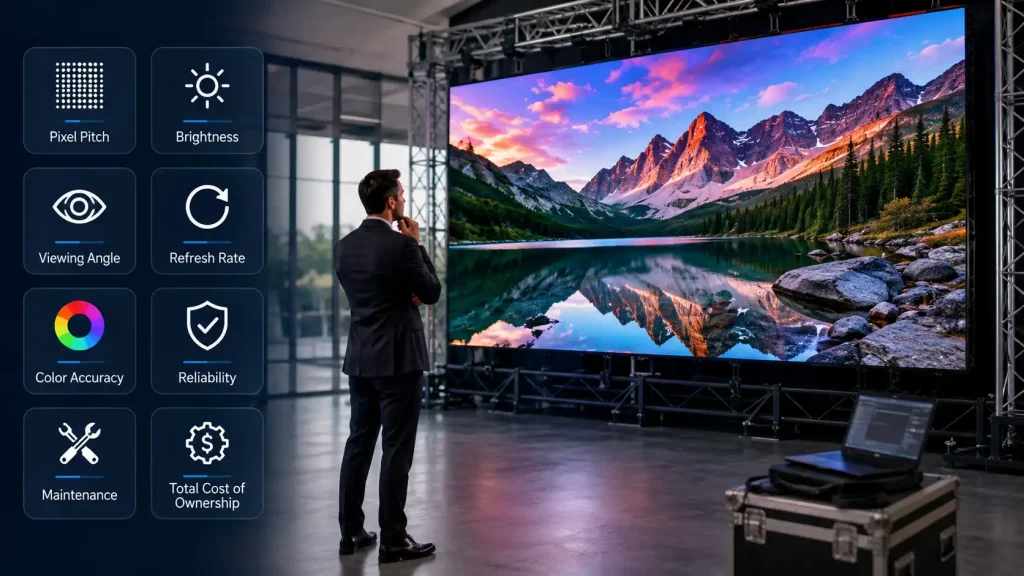
Two SMD screens can carry identical pixel pitch on the quotation and behave completely differently after eighteen months. The difference sits in components buyers rarely ask about: lamp bin consistency, driver IC grade, power supply headroom and warranty wording. This guide lists the twelve features that decide image quality, service life and running cost, in the order a professional buyer should verify them.
Image Specifications: Features 1 to 4
1. Pixel Pitch Against Viewing Distance
Pixel pitch is the centre to centre distance between lamps. The working rule is simple: the minimum comfortable viewing distance in metres roughly equals the pitch in millimetres. A 2.5 mm screen reads clearly from 2.5 m. Specifying a tighter pitch than the room needs wastes budget, because the extra resolution sits below the eye resolving limit.
2. Brightness Matched to the Environment
Indoor modules deliver 450 to 600 nits. Outdoor modules deliver 4000 to 5000 nits. Placing an indoor module behind glass facing a sunlit street produces a washed out display that no processor setting can rescue. Take a lux reading at the installed position before approving brightness.
3. Refresh Rate, Frame Rate and Greyscale Depth
Refresh rate controls camera performance. Panels at 1920 Hz show scan bands on video; 3840 Hz removes them at normal shutter speeds. Frame rate should sit at 50 Hz or 60 Hz. Greyscale depth is the specification almost no quotation mentions: 14 bit or 16 bit processing preserves detail in dark scenes, while low bit depth produces banding across gradients and flat black areas.
4. Contrast, Colour Gamut and Uniformity
Look for contrast of 5000:1 or better on indoor modules, colour gamut at 100 percent NTSC or above, brightness uniformity of 97 percent or better, and adjustable colour temperature across 3000 K to 15000 K. Ask whether pixel by pixel brightness and chroma correction is applied at the factory and whether the correction file ships with the screen. Without it, modules from different batches show visible patches on a white test frame.
Components That Decide Lifespan: Features 5 to 8
5. Lamp Brand and Bin Consistency
Lamps are sorted into brightness and wavelength bins. Modules built from mixed bins look uniform on day one and drift apart within a year. Require the lamp manufacturer name and bin code in writing, and require every module for one screen to come from a single production batch.
6. Driver IC and Power Supply Headroom
Constant current driver ICs hold brightness steady as supply voltage moves, which matters on a 230 V grid that sags under load. Power supplies should run at no more than 80 percent of rated capacity at peak white. A supply sized exactly to peak draw fails first and takes modules with it.
7. Receiving Card and Video Processor
The receiving card and processor determine scan quality, low brightness performance and how the screen behaves during a power event. Ask for the brand and model of both, confirm the processor supports your source resolution natively, and confirm a spare receiving card is stocked locally.
8. Cabinet Build, Flatness and Service Access
Surface flatness of 0.5 mm or better prevents visible seam shadows across the screen. Front maintenance access lets a technician replace a module without dismantling the structure, which is essential where the screen sits tight against a wall. Die cast aluminium cabinets hold alignment better than folded steel over time.
Commercial and Environmental Terms: Features 9 to 12
9. Ingress Protection and Operating Temperature
Outdoor screens should carry IP65 rating and an operating range covering minus 10 C to at least 40 C. Ask for the front and rear ratings separately, because many modules protect the face better than the back. Indoor and semi outdoor modules carry far lower ratings and belong under cover.
10. Power Consumption in Watts per Square Metre
This is the missing number in most quotations, and it drives your electricity bill. Indoor modules average 40 to 155 W per square metre with peaks near 460 W. Outdoor modules average 235 to 248 W per square metre with peaks near 740 W. Multiply average draw by area, daily hours and days, then apply your commercial tariff.
11. Warranty Duration and Wording
Warranty length varies sharply by product type, and the variation is legitimate rather than a discount signal. Indoor and ultra thin modules commonly carry four year cover; outdoor modules commonly carry one year because of thermal and weather stress. Read what the document excludes: lightning, water ingress through third party structures, and voltage damage are the usual carve outs.
12. Supplier Capability and Local Engineering
The panel is a commodity. Installation, commissioning and service response are not. Confirm the supplier holds spare modules for your exact SKU inside Pakistan, employs its own installation team, and can produce completed project references. SMDLED prioritizes local engineering capability as a core requirement. Our project record across national installations is set out on our company profile.
Specification to Application Matching
| Deployment | Pitch | Brightness | Refresh | Protection |
| Boardroom or control room | 0.945 to 1.538 mm | 450 to 600 nits | 3840 Hz | Indoor, front service |
| Retail showroom wall | 1.86 to 2.5 mm | 500 to 600 nits | 3840 Hz | Indoor |
| Auditorium or banquet stage | 2.5 to 3 mm | 600 nits | 3840 Hz | Indoor, rigging rated |
| Building facade or roadside board | 4 to 10 mm | 4000 to 5000 nits | 1920 to 3840 Hz | IP65, minus 10 C to 40 C |
| Petrol station or drive through | 5 to 8 mm | 5000 nits | 1920 Hz | IP65, surge protected |
| Hall or campus information board | 3 to 4 mm | 500 nits | 1920 Hz | Indoor |
How to Spot a Downgraded or Refurbished Panel
Pakistan has an active grey market in relabelled modules. Run these checks at handover, before payment clears.
- Display a full white frame for ten minutes. Colour patches between modules indicate mixed lamp bins or reused stock.
- Display full black. Visible glow or uneven dark patches indicate poor driver IC grade.
- Turn a module over. A genuine module carries a batch label, date code and model number. Missing or overwritten labels are a warning.
- Inspect solder joints under light. Resoldered joints and flux residue indicate repair work rather than new production.
- Compare driver IC date codes against the invoice year.
- Request the factory brightness correction file. Refurbished stock rarely has one.
Total Cost of Ownership Framework
Compare quotations on five year cost, not sticker price. Build the comparison in six lines.
| Cost line | What to request from the supplier |
| Capital cost | Modules, cabinets, processor, power distribution, structure and installation itemised separately |
| Electricity across five years | Average W per square metre multiplied by area, daily hours and your tariff |
| Stabilisation and backup | Servo stabiliser and UPS sizing for the processor and receiving cards |
| Preventive maintenance | Cleaning and inspection frequency, quoted per visit |
| Spare modules | 3 to 5 percent of installed count, same batch, quoted with the main order |
| Content operation | Who schedules content, and on which software licence |
A screen that costs 15 percent more but draws 30 percent less power and lasts twice as long wins the five year comparison every time. The revenue side of that equation is covered in how SMD screens improve digital advertising performance.
Pakistan Buying Conditions to Account For
| Condition | Impact on your purchase | Action |
| Voltage fluctuation on the 230 V supply | Premature power supply and driver failure | Servo stabiliser plus surge protection at the distribution board |
| Commercial tariff near Rs 44 per unit | Electricity becomes a material five year cost line | Compare average W per square metre between quotations |
| Lahore summer peaks approaching 45 C | Outdoor modules operate close to their thermal ceiling | Confirm operating range and specify rear ventilation clearance |
| Smog season from October to January | Particulate settles on module faces and cuts output | Agree a cleaning schedule inside the maintenance contract |
| Monsoon from July to mid September | Water ingress through structure penetrations | IP65 modules plus sealed cable entry and a drip loop |
| Import lead times on non standard SKUs | One failed module can idle the screen for weeks | Buy spares in the original batch, not later |
Verification Checklist Before You Release Payment
- Lamp brand, bin code and single batch confirmation in writing.
- Driver IC model and power supply capacity checked against measured peak draw.
- Receiving card and processor brand, with local spare stock confirmed.
- Average and maximum W per square metre stated on the quotation.
- Warranty document naming duration, exclusions and response time.
- Brightness correction file, pixel map and as built drawing handed over.
- Signed test report from a full white, full black and colour bar run.
Match the requirement to the right product family before comparing prices. Interior deployments run through our indoor SMD screen solutions, weather exposed sites through outdoor SMD screen solutions, slim architectural builds through the ultra thin SMD LED screen module, and calibrated high resolution walls through the HDR 4K SMD video wall.
Get the Specification Right Before the Quotation
Send your viewing distance, ambient light condition, mounting surface and daily operating hours. The correct specification follows from those four inputs. Browse the complete SMD screen product range, read further technical breakdowns on our display technology blog, then request a site survey and itemised quotation from our SMDLED Lahore engineering team.