 Outdoor SMD Screens
 Indoor SMD Screens
 Flexible SMD Screens

Common Features to Consider Before Buying Professional SMD Screen Solutions
Two SMD screens can carry identical pixel pitch on the quotation and behave quite differently after eighteen months. The difference…
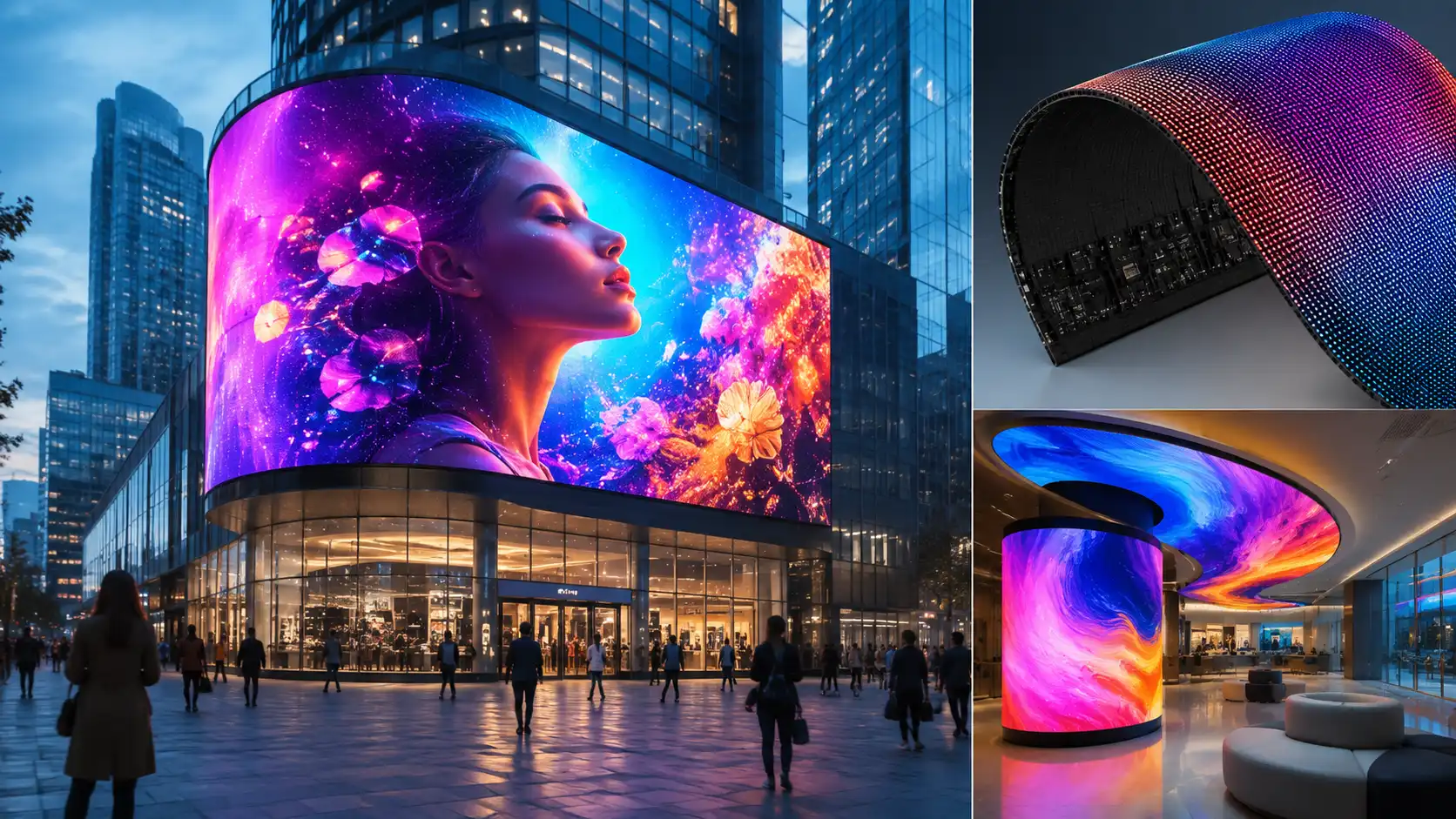
Flat LED panels suit flat walls, but creative advertising often involves other shapes: retail columns, curved shopfronts, wave ceilings, spiral staircases and cylindrical brand totems. Flexible LED modules use a soft, flexible backing that can follow these curves within the manufacturer’s stated bend limits. This guide covers where flexible displays work better than rigid cabinets, where they fall short, and how to budget for the full installed project in Pakistan.
A rigid module mounts its LEDs on a stiff circuit board inside a cabinet. A flexible module mounts them on a thin flexible circuit with a soft polymer mask, and is usually fixed to a backing structure with magnets rather than a cabinet frame. This lets it curve convex or concave without cracking solder joints, as long as it is not bent tighter than its minimum bend radius. Bending tighter than the minimum radius can stress the joints and LEDs and may make pixel spacing look uneven along the curve.
The values below are illustrative of what is commonly offered; actual figures vary by model, so always use the datasheet for the product you are buying.
| Attribute | Example value | What it controls |
| Pixel pitch | About 1.25 mm to 4 mm | Close-range legibility on the curve |
| Module size | Often 320 x 160 mm | How smoothly the surface follows a radius |
| Module thickness | A few millimetres (check datasheet) | Whether the display can sit flush in a recess |
| Weight | Module weight per square metre is on the datasheet; the assembled system with backing structure weighs more | Substructure load design |
| Brightness | Typically indoor levels, often several hundred nits and above | Indoor use; not for sunlit facades |
| Minimum bend radius | Stated in millimetres by the manufacturer | Tightest curve the surface can follow |
| Refresh rate | Varies by driver IC | Camera and phone capture quality |
| Ingress protection | Often IP43 or similar on indoor models | IP43 means protection against solid objects over 1 mm and spraying water up to 60 degrees from vertical; it is not weatherproof |
| Operating temperature | Stated on the datasheet | Suitability for atriums and shopfronts |
| Maximum power draw | Stated per square metre on the datasheet | Circuit sizing and running cost |
Mall atriums often have structural columns that can be wrapped in a continuous 360-degree display, visible from every approach. As an example, a 0.9 m diameter column 3 m high has a surface of about 8.5 square metres (π × 0.9 × 3). Check that the column diameter is comfortably above the module’s minimum bend radius, and get permission from the building owner.
Flexible modules can follow concave and convex sweeps across retail entrances, hotel lobbies and showroom ceilings, fixed to a backing structure built to the intended curve. Ceiling installations need particular care with secure fixings, load design and service access. See also our notes on flexible LED screens in creative installations.
Reception desks, exhibition pods and stage props can carry thin flexible modules without adding much depth. Vehicle-mounted installations need a product the manufacturer approves for vibration and outdoor exposure, plus compliance with vehicle and road-safety rules; standard indoor flexible modules are not designed for this. Customer reaction to these installations is covered in how flexible SMD displays create unique visual experiences.
These are typical starting points; confirm with viewing-distance and site checks.
| Project type | Typical pitch | Surface geometry | Critical requirement |
| Mall column wrap, shoppers within 2 m | About 1.86 mm to 2.5 mm | Full cylinder | Seam alignment at the closing joint; diameter above minimum bend radius |
| Retail shopfront curve | About 2.5 mm | Gentle convex sweep | Ambient light check before choosing brightness |
| Hotel lobby wave ceiling | About 3 mm to 4 mm | Compound curve viewed from 4 m or more | Engineered load path, secure fixings and service access |
| Reception desk fascia | About 1.25 mm to 1.86 mm | Shallow concave | Close viewing distance |
| Exhibition pod or product plinth | About 2.5 mm | Multiple short radii | Radii within bend limits; careful install and removal |
| Spiral staircase ribbon | About 3 mm | Helical, varying radius | Geometry correction in the content |
Buyers often compare only LED module costs and miss the frame. A flexible display needs a fabricated backing that holds the exact curve, carries the assembled load and allows service access to every module. On tight radii and compound curves, the substructure can be a significant share of the project. Plan the budget in separate lines:
SMDLED can help with substructure planning for curved projects, working with qualified engineers. Ask for the substructure drawing before you approve a quotation; a quote that covers only the LED area for a curved job is incomplete.
Calculate electricity from area and the datasheet’s average power, not panel count. As an illustration, if the 8.5 square metre column above averaged 130 W per square metre, it would draw about 1.1 kW. Running 14 hours a day for 30 days, that is roughly 464 units (kWh) a month. Multiply by the per-unit rate on your own bill to estimate the cost; your actual average power depends on the model, brightness and content.
| Factor | Printed vinyl column wrap | Backlit acrylic curve | Flexible LED display |
| Creative change | Reprint and reinstall each time | Reprint the graphic layer | Upload new content |
| Campaigns per year | Limited by printing | Limited by printing | Not limited by printing; content can change by time of day |
| Motion and video | None | None | Full motion video |
| Electricity | None | Low | Moderate; depends on model and brightness |
| Service life | Fades over time | Graphics fade over time | Depends on model, operating hours, heat and maintenance; check datasheet and warranty |
| Repair | Full rewrap | Full graphic panel | Individual module replacement |
The value depends on how often content changes. A brand that changes creative twice a year may gain little, while a mall selling slots to several advertisers or a retailer running frequent promotions may get more value, depending on their costs and income. See the wider discussion in LED video walls for shopping mall advertising.
| Condition | Local reality | Design response |
| Atrium daylight | Glazed mall roofs can make interiors very bright at midday | Measure light levels at the exact position before choosing brightness |
| Smog-season dust | Airborne dust rises in winter in some cities | Regular dry, soft cleaning with the screen powered off, following the manufacturer’s instructions |
| Supply voltage | Voltage fluctuations are common | Have a qualified electrician specify protection or stabilisation for the power supplies |
| Monsoon humidity | Humid months in summer | Keep the cavity ventilated (not sealed), rely on the building’s climate control, and store spares with desiccant |
| Summer heat | Interiors can get hot when cooling lags | Ventilated cavity and no sealed enclosure |
| Spare parts | Curved projects use non-standard module counts | Order spare modules from the original batch for colour match |
Rigid screens remain the right choice for flat walls and sunlit positions. Compare options through our indoor SMD screen solutions, the slim ultra thin SMD screen module and our flexible SMD screens page.
Send the architectural drawing or a photograph with dimensions before choosing a module. Radius, viewing distance and ambient light decide the specification. Browse the SMD and LED display catalogue, then book a site survey with our SMDLED Lahore team for a curve assessment, substructure proposal and installed cost breakdown.
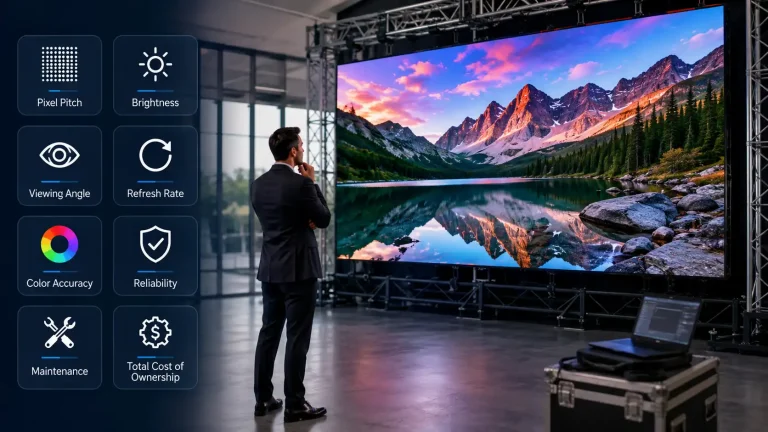
Two SMD screens can carry identical pixel pitch on the quotation and behave quite differently after eighteen months. The difference…
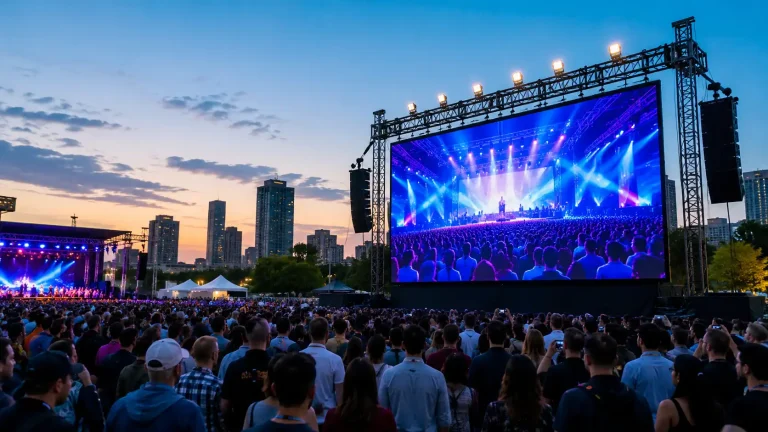
A printed billboard carries one message until it is replaced. An outdoor LED screen can carry several messages in a…
Why businesses choose high resolution indoor SMD screens: pixel pitch and viewing distance, the specifications to check on a datasheet,…