
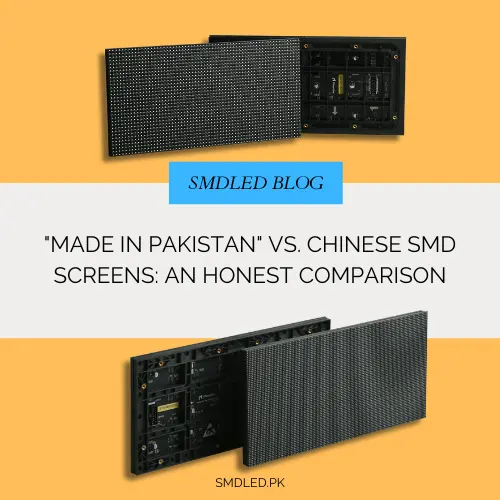
When you decide to invest millions in a digital video wall, the origin of the product matters. In Pakistan, the market is flooded with two distinct types of products: fully imported “Brand Name” screens from China, and locally assembled screens often marketed as “Made in Pakistan.”
For a buyer in 2025, the distinction is often blurred by aggressive marketing. At SMD LED, we believe in radical transparency. We want you to know exactly what you are paying for. This article peels back the layers of the Made in Pakistan vs Chinese SMD screens debate to help you decide which route offers the best value for your business.
The Myth of “Made in Pakistan”
First, let’s clarify a technical reality: Pakistan does not manufacture LED diode chips.
The core technology—the tiny red, green, and blue light-emitting diodes—are almost exclusively manufactured in China, Taiwan, or Japan. When a vendor says a screen is “Made in Pakistan,” they usually mean “Assembled in Pakistan.”
What is Local Assembly?
Local assembly involves importing the LED modules (the square tiles with lights), power supplies, and control cards separately. The vendor then fabricates the steel or iron cabinet locally in a welding workshop (e.g., in Gujranwala or Karachi) and wires the components together.
What is a “Chinese Screen”?
A “Chinese Screen” typically refers to a unit that is fully assembled, tested, and calibrated in a high-tech factory in Shenzhen (like Unilumin, Absen, or Qiangli) and imported as a complete cabinet.
Quality Comparison: The Devil in the Details
The difference in Made in Pakistan vs Chinese SMD screens often comes down to the housing and the assembly precision.
1. Cabinet Fabrication (The Rust Factor)
- Chinese Import: These usually come in Die-Cast Aluminum or Magnesium Alloy cabinets. They are lightweight, machine-molded (CNC), and naturally rust-proof. The precision ensures zero gaps between modules.
- Locally Assembled: Most local vendors use Iron or Steel sheets, bent and welded by hand.
- The Risk: Iron rusts. In humid cities like Karachi or Lahore, a locally made iron cabinet can start corroding within 18 months, leading to moisture ingress and screen failure.
- The Exception: High-end local assemblers (like SMD LED) use Galvanized sheets and proper powder coating to mimic factory standards, but this costs more.
2. Wiring and Soldering
- Chinese Import: Assembled by robots. The cabling is neat, standardized, and uses high-grade ribbon cables.
- Locally Assembled: Done by technicians. If the technician is unskilled, you might get “spaghetti wiring” inside the cabinet. Loose connections are the #1 cause of flickering screens in Pakistan.
3. Calibration
- Chinese Import: Factory calibrated. The entire batch of LEDs is color-matched before shipping.
- Locally Assembled: Often assembled from “leftover” batches of modules to save cost. This can result in a “checkerboard” effect where some squares look slightly redder or brighter than others.
Cost Comparison: Why Local is Cheaper
If imported screens are better built, why do people buy local? The answer is simple: Price and Customization.
- Import Duties: Importing a fully finished LED cabinet attracts higher duty taxes compared to importing raw “parts” (modules and supplies). Local assemblers pass these tax savings on to you.
- Freight: Shipping heavy iron cabinets from China is expensive. Making the heavy metal part in Pakistan saves thousands of dollars in sea freight.
- Custom Sizes: If you need a screen exactly 11.5 feet wide, a Chinese factory might struggle because they have standard sizes (e.g., 960mm). A local fabricator can cut the steel frame to your exact inch, fitting perfectly into your shop’s architecture.
The Support Factor: The Local Ace Card
This is where the “Made in Pakistan” option shines in the Made in Pakistan vs Chinese SMD screens battle.
Repairability
- Chinese Import: If a specialized hub card or proprietary power supply fails, you might have to wait 3 weeks for a replacement part to fly in from Shenzhen.
- Locally Assembled: The components are generic and standardized (Hub75 protocol). If a power supply blows, we can swap it with a generic Meanwell unit available at Hall Road instantly. The screen is back up in hours, not weeks.
Warranty
Claiming a warranty from a Chinese manufacturer is a bureaucratic nightmare involving shipping parts back. A local assembler provides an on-site warranty. At SMD LED, our technicians visit your site to fix issues, regardless of whether the parts are Chinese or the frame is local.
The Verdict: Which One Should You Buy?
To simplify the Made in Pakistan vs Chinese SMD screens decision, use this checklist:
Choose Fully Imported (Chinese) If:
- You are installing in Karachi or Coastal Areas (Aluminum is mandatory to prevent rust).
- You need a Rental Screen that will be moved frequently (Lightweight cabinets are essential).
- You require 4K/8K Resolution (P1.2 – P1.8) where micrometer precision is required.
Choose Locally Assembled (Pakistani) If:
- You are on a Budget. Local assembly can be 20-30% cheaper.
- You need a Custom Size to fit a specific wall niche.
- You are in Punjab/Upcountry where rust is less of an issue.
- You value Instant Repair over aesthetic perfection of the cabinet (which is hidden anyway).
Conclusion
The “Made in Pakistan” tag isn’t a lie; it’s a manufacturing method. It combines Chinese tech with Pakistani craftsmanship. While it may lack the robotic precision of a Shenzhen factory, it offers unbeatable value and repairability for the local market.
At SMD LED, we offer both. We import premium Die-Cast cabinets for our high-end clients and provide robust, locally fabricated solutions for budget-conscious projects. The choice is yours, but the honesty is ours.
Explore our range of Indoor Modules and Outdoor Cabinets to see the quality difference yourself.
Frequently Asked Questions (FAQs)
1. Is “Made in Pakistan” SMD screen quality lower than Chinese? Not necessarily the image quality. The visual quality depends on the LED module (e.g., Nationstar vs. Kinglight), which is imported in both cases. The difference lies in the structural quality (cabinet) and finish.
2. Do locally assembled screens have a warranty? Yes. Reputable local assemblers like SMD LED offer 1-3 year warranties. In fact, local warranties are often easier to claim than international manufacturer warranties.
3. Why do locally made screens get rusted? Local screens are often made of Iron (MS Sheet) to save cost. If not properly powder-coated or galvanized, they rust. We recommend demanding “Galvanized Iron” or “Aluminum Profile” even for local assembly to ensure longevity.
4. Can I get a curved screen made in Pakistan? Yes. Local fabricators are skilled at bending steel. We can create curved structures locally and mount flexible LED modules on them, often at a fraction of the cost of importing a pre-curved cabinet.
5. Which is better for a wedding hall: Local or Imported? For a fixed installation in a wedding hall, a Locally Assembled screen is usually the better choice. It is cheaper, and since the screen is fixed to a wall indoors, the heavy weight of the iron cabinet doesn’t matter.
CTA
Still undecided? Let us show you the difference side-by-side. Contact us to visit our showroom and compare a locally built unit against a premium import. Quality you can see, prices you can trust.