 Outdoor SMD Screens
 Indoor SMD Screens
 Flexible SMD Screens

Why Faisalabad’s Textile Industry is Investing in SMD Technology
How LED screens can help textile mills in Faisalabad and similar industrial areas: production dashboards fed from existing systems, showroom…
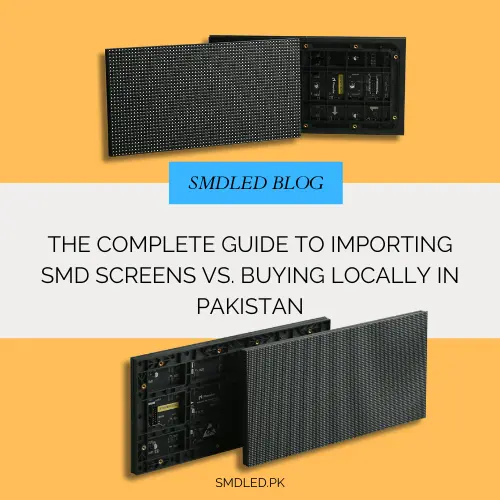
As a business owner in Pakistan, you want the best value. When an LED module on an overseas marketplace looks cheaper than a local supplier’s quotation, the choice can seem simple. Why pay more?
However, the journey from a factory abroad to a billboard in Faisalabad involves practical and technical hurdles. The question of importing SMD screens vs buying locally is not just about the listed price; it is about the full landed cost and the risks you take on.
At SMD LED, we believe you should know what to compare, whether you import yourself or buy from a local supplier. This guide walks you through the main factors so you can make an informed decision. It is general information, not customs or legal advice.
The price shown online is often “FOB” (Free on Board). This means the supplier loads the goods onto the ship at their port; from that point, shipping, insurance, import clearance and delivery are your responsibility.
Also check what the listing actually includes: modules only, or complete cabinets with power supplies, receiving cards, controller, cables and spare parts. A low module price may not include everything needed for a working screen.
Only then can you compare the import route fairly with a local quotation, which is where the real comparison of importing SMD screens vs buying locally begins.
The landed cost is everything it takes to get the goods to your site. It typically includes:
Reality check: once these are added, the gap between the online price and a local quotation can narrow considerably, especially when the local quotation includes warranty, installation and support. Do the full calculation for your own order.
When weighing importing SMD screens vs buying locally, consider the risks as well as the costs.
If some modules arrive with dead pixels or colour mismatch, returning them to an overseas supplier can be slow and costly. Check the supplier’s warranty and return terms before ordering.
Goods can be damaged in transit, for example by water or crushed packaging. If you import yourself, you handle any insurance claim. When you buy locally, the supplier normally deals with transit issues before delivery.
Replacement modules match best when they come from the same production batch, so colour and brightness stay uniform. Plan spare modules at the time of purchase, whichever route you choose, and ask your supplier how spares and colour matching are handled.
Buying from a reputable Pakistani supplier means you have a local contact for warranty, support and service.
When you buy a product such as the BIA Indoor SMD Screen Module from a local supplier, warranty claims are handled locally instead of through an overseas seller. Ask for warranty terms in writing. Good electrical protection, designed by a qualified electrician, also helps protect power supplies from supply problems.
An SMD screen is not a TV. It needs a properly designed supporting structure, safe electrical work and controller configuration (for example NovaStar or Linsn systems).
| Feature | Direct Import | Buying Locally |
|---|---|---|
| Listed Cost | Often lower | Often higher |
| Landed Cost | Listed cost plus freight, insurance, clearance and handling | As quoted; check what is included |
| Warranty | Through the overseas supplier; can be harder to claim | Through the local supplier; check terms |
| Delivery Time | Usually several weeks, including shipping and clearance | Depends on stock; often shorter |
| Risk | You carry shipping, clearance and quality risk | Lower, but depends on the supplier |
| Installation | Your responsibility | Depends on the quotation |
Importing directly can make sense in some cases:
For many businesses, such as retailers, offices and wedding halls, the effort and risk of importing SMD screens vs buying locally often favour the local option.
A low online price may not stay low once freight, clearance, handling and risk are counted, and after-sales support is harder from abroad. Compare the full landed cost and the support you will get, not just the listed price.
SMD LED supplies SMD screens in Pakistan, including our own BIA brand. Browse our Products or Contact Us for a written quotation that clearly lists what is included.
1. How do I find out the current import costs for SMD screens in Pakistan? They depend on the official classification and valuation of the goods and change over time. Ask a licensed customs agent for current written guidance for your exact goods before you order.
2. Can I import a small SMD screen via air freight? Yes, but air freight is charged by weight or volume and LED cabinets are heavy, so it can be expensive. Get a freight quotation for your shipment.
3. Why is the local price higher than the online price? A local quotation usually covers the product plus shipping, import clearance, warehousing, warranty and often installation and support. Once you calculate the landed cost of an import, the difference may be much smaller.
4. Does SMD LED provide a warranty for its screens? Yes, warranty terms depend on the product. Ask us for the terms for your product in writing.
5. How long does it take to import a screen vs buying locally? Importing by sea usually takes several weeks including clearance. Buying locally from SMD LED can be quicker if stock is available; contact us for current lead times.
Want to compare options for your project? Contact us for a consultation and a written local quotation.

How LED screens can help textile mills in Faisalabad and similar industrial areas: production dashboards fed from existing systems, showroom…

For years, marketing managers in Pakistan faced a common problem: how to launch a synchronised campaign across Islamabad, Lahore and…

Tariq Road is one of Karachi's busiest retail areas, and static signboards struggle to stand out. This guide looks at…