
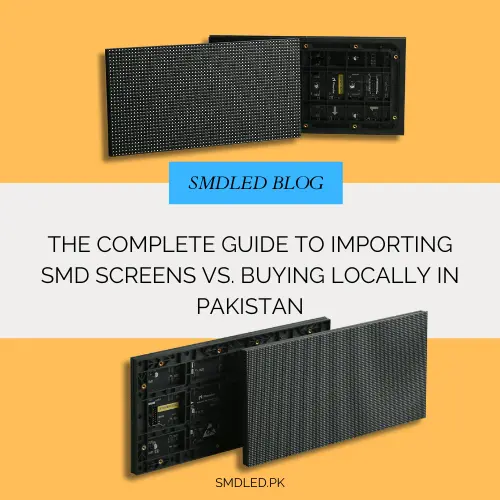
As a business owner in Pakistan, you always want the best value. When you see a P3 Outdoor Module listed on a Chinese marketplace for $15, and a local supplier quotes PKR 6,500, the math seems simple. Why pay more?
However, the journey from a warehouse in Shenzhen to a billboard in Faisalabad is fraught with financial and technical hurdles. The debate of importing SMD screens vs buying locally is not just about the sticker price; it is about the Landed Cost and the Risk Premium.
At SMD LED, we believe in transparency. Whether you choose to import yourself or buy from us, you deserve to know the facts. This guide will walk you through the real costs of importing in 2025 so you can make an informed decision.
1. The “Alibaba Illusion”: Understanding FOB Prices
The price you see online is usually “FOB” (Free on Board). This means the supplier will put the goods on a ship in China, but after that, you are on your own.
For example, a 10×20 ft screen might cost $10,000 on Alibaba.
- Exchange Rate (Est. 2025): 1 USD = 290 PKR (Hypothetical calculation base).
- Base Price: PKR 2,900,000.
This looks attractive compared to a local quote of PKR 4,500,000. But this is where the illusion ends, and the reality of importing SMD screens vs buying locally begins.
2. The Landed Cost: Duties, Taxes, and Freight
To get that screen into Pakistan, you must navigate the Federal Board of Revenue (FBR) and Pakistan Customs. Here is the typical breakdown for HS Code 8528.5900 (LED Display Units) or similar categories:
- Customs Duty (CD): Approx 11% – 20% (depending on specific module type).
- Regulatory Duty (RD): Often applied to “luxury” electronics, ranging from 10% to 50%.
- Additional Customs Duty (ACD): 2% – 7%.
- Sales Tax (GST): 18% on the duty-paid value.
- Income Tax (WHT): 5.5% to 11% for commercial importers.
The Reality Check: By the time you add Sea Freight ($1,200 per container), Insurance, Clearing Agent fees, and Port Handling charges (wharfage/demurrage), the total tax burden often exceeds 60-80% of the product value.
Your PKR 2.9 Million screen now costs nearly PKR 5.2 Million before it even reaches your site. Suddenly, the local quote includes warranty and installation looks much more reasonable.
3. The Risk Factors: What Can Go Wrong?
When weighing importing SMD screens vs buying locally, you must price in the risks.
Dead Pixels and Batch Issues
LED modules are sensitive. If your shipment arrives and 5% of the modules have “dead pixels” (black dots) or color mismatch issues, you cannot simply return them to China. Shipping them back for warranty repair costs more than the modules themselves.
Shipping Damage
We have seen containers arrive at Karachi Port with water damage or crushed crates. If you imported it yourself, dealing with insurance claims is a months-long battle. If you buy locally, it is the supplier’s headache, not yours.
No Spare Parts
SMD screens need spare modules from the exact same manufacturing batch for color calibration. If a module fails 6 months later, you cannot buy a generic replacement from the market; the colors won’t match. Local suppliers like SMD LED stock extra spares for every client to ensure 100% color uniformity for years.
4. The Local Advantage: Why Smart Businesses Buy Locally
Buying from a reputable Pakistani supplier is not just purchasing hardware; it is purchasing an SLA (Service Level Agreement).
Warranty That Means Something
When you buy a BIA Indoor SMD Screen Module from us, you get a local warranty. If a power supply blows up due to a WAPDA surge, our technician is a phone call away. You don’t have to email a supplier in Shenzhen who might not reply.
Professional Installation
An SMD screen is not a TV; it requires structural engineering, precise cabling, and software configuration (Novastar/Linsn).
- DIY Import: You have to hire a freelance welder and an IT guy, hoping they know what they are doing.
- Local Buy: We provide a turnkey solution, including the steel structure, electrical DB, and calibration.
5. Comparison Table: DIY Import vs. Local Supplier
| Feature | Direct Import (DIY) | Buying Locally (SMD LED) |
|---|---|---|
| Upfront Cost | Low ($) | Medium ($$) |
| Landed Cost | High (Duties + Taxes + Freight) | Fixed (Quoted Price) |
| Warranty | Manufacturer (China) – Hard to claim | Local On-Site Support |
| Delivery Time | 45 – 60 Days (Sea Freight) | Immediate / 1 Week |
| Risk | High (Customs, Damage, Quality) | Zero (We handle it) |
| Installation | Your Responsibility | Included / Professional Team |
6. When Should You Import?
We are honest experts. There is a time to import directly:
- You are a reseller: If you plan to sell screens to others and have your own technical team.
- Huge Scale: If you are building a massive stadium screen (over 3000 sq. ft.), the bulk savings might outweigh the risks, provided you hire a professional clearing agent.
For 95% of businesses (retailers, corporate offices, wedding halls), the complexities of importing SMD screens vs buying locally heavily favor the local option.
Conclusion
The allure of saving money by importing directly often evaporates once the container hits Karachi Port. The hidden costs of duties, the stress of clearance, and the lack of after-sales support make it a risky gamble for end-users.
By partnering with a local leader like SMD LED, you secure not just a screen, but peace of mind. We handle the logistics, the quality control, and the maintenance, allowing you to focus on your business.
Ready to get a hassle-free digital display? Browse our ready-to-install Products or Contact Us for a quote that includes everything—no hidden surprises.
Frequently Asked Questions (FAQs)
1. What is the current customs duty on SMD screens in Pakistan for 2025? The total tax impact (Customs Duty + Regulatory Duty + Sales Tax + ACD) usually ranges between 60% to 85% of the assessed value. Customs valuation rulings often assess the value higher than your actual invoice, leading to higher taxes.
2. Can I import a small SMD screen via air freight? You can, but it is prohibitively expensive. Air freight rates in 2025 are around $5.00 – $7.00 per kg. Since SMD screens and cabinets are heavy, air freight often costs more than the screen itself.
3. Why is the local price higher than the Alibaba price? Local prices include the product cost, plus all the duties, taxes, freight, clearing charges, warehousing, warranty provision, and installation labor. When you calculate the “Landed Cost” of an import, the local price is often very competitive.
4. Does SMD LED provide a warranty for its screens? Yes. We provide comprehensive local warranties ranging from 1 to 3 years depending on the product series. This covers parts and service, something a Chinese supplier cannot offer remotely.
5. How long does it take to import a screen vs buying locally? Importing via sea freight takes 45 to 60 days (transit + customs clearance). Buying locally from SMD LED means you can have your screen installed within 3 to 7 days if the stock is available.
CTA
Skip the customs headaches and the waiting game. Get a premium, warrantied SMD screen installed this week. Contact us now for a specialized consultation and a competitive local quote!