 Outdoor SMD Screens
 Indoor SMD Screens
 Flexible SMD Screens

Outdoor vs Indoor LED Screens: Brightness, IP Rating and Cost
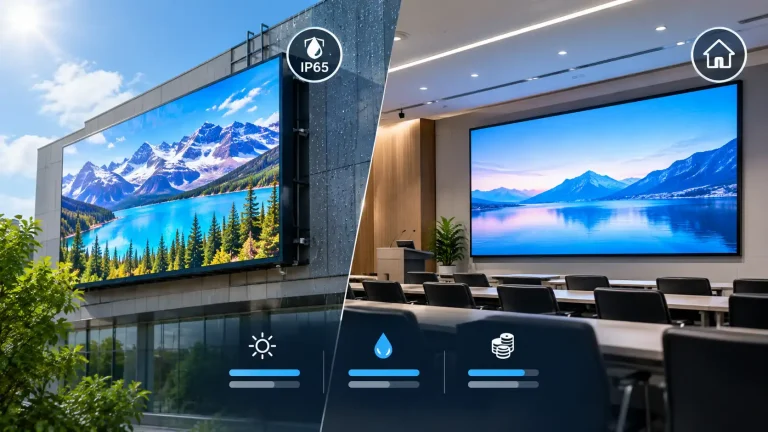
An indoor LED screen and an outdoor LED screen can look identical in a showroom. Put both on a Lahore…
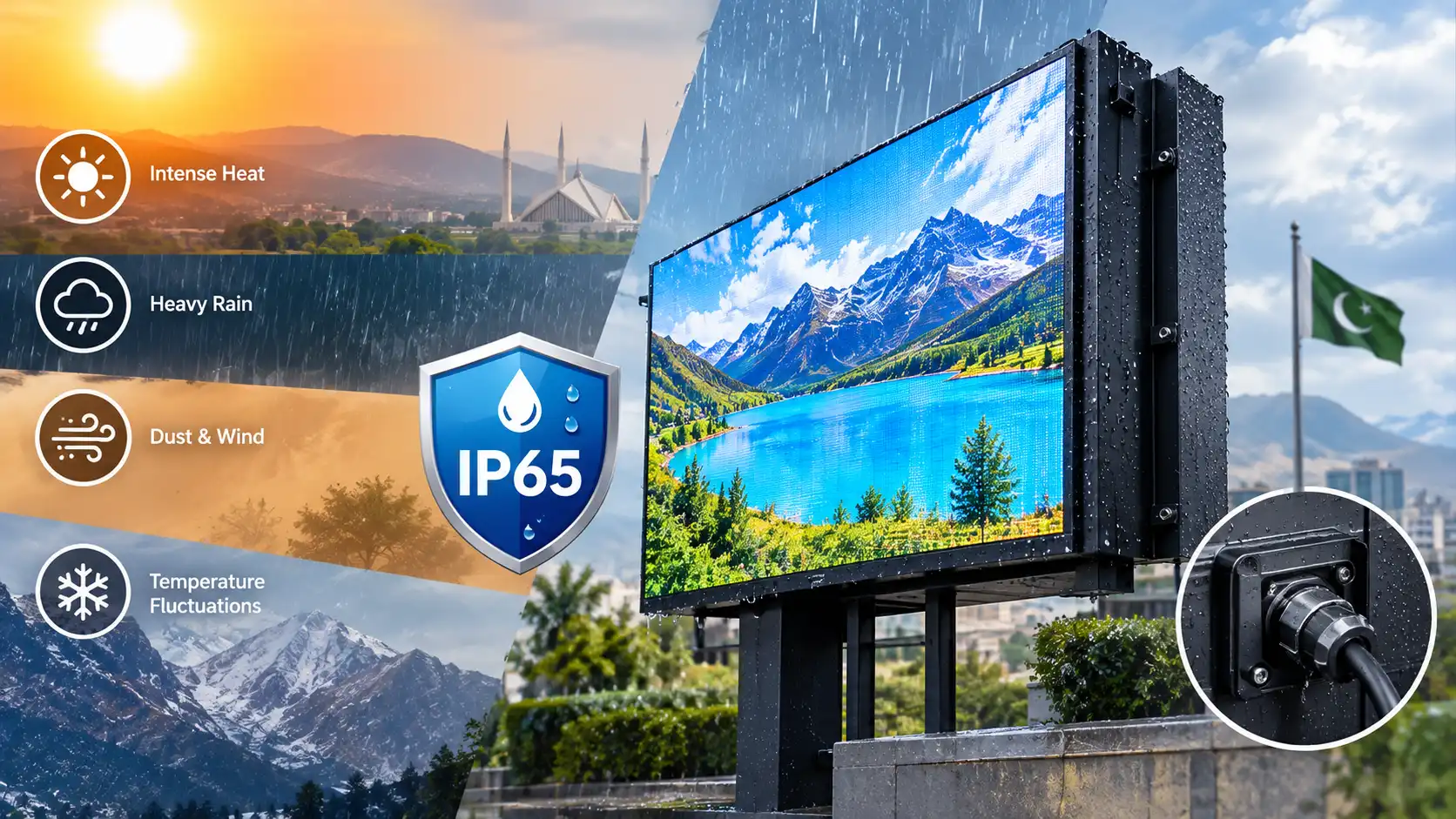
“IP65” appears on almost every outdoor LED screen quotation in Pakistan. It sounds like a guarantee. It is not.
IP65 tells you an enclosure passed standard dust and water-jet tests. It says nothing about extreme summer heat in upper Sindh, salt corrosion on a Karachi seafront, or a cable gland left loose after a service visit. Those are common causes of outdoor screen problems here.
This guide explains what IP65 covers, where it stops, and what different Pakistani climates may demand on top of it. It is general guidance: the final specification for any site should come from a site assessment, the manufacturer’s documentation and qualified engineers.
IP ratings are defined in the IEC 60529 standard, which sets out the test conditions in detail.
That is good protection against dust storms and driving monsoon rain. It is not protection against standing water or submersion. A rating applies to the tested product as installed according to the manufacturer’s instructions; ask the supplier which parts (front, rear, whole cabinet) carry which rating. We compare ratings in our IP65 vs IP68 waterproofing guide.
Here is where many buyers get caught. An IP rating says nothing about:
| Threat | Covered by IP65? | What Protects Against It |
| Dust storms | Dust ingress, yes | Dust-tight seals, filtered ventilation |
| Driving rain | Within the test conditions | Sealed modules and gaskets, correct installation |
| High ambient heat | No | Ventilation design, components rated for the site temperature |
| UV degradation of masks and gaskets | No | UV-stabilised materials |
| Salt air corrosion | No | Corrosion-resistant cabinets, factory coatings, suitable connectors |
| Condensation inside cabinets | No | Manufacturer’s breather or anti-condensation design |
| Lightning and voltage surges | No | Earthing, surge protection and lightning protection designed by qualified engineers |
| Wind load | No | Structural engineering |
| Poor workmanship after servicing | No | Manufacturer-approved re-sealing procedures by trained technicians |
So IP65 is a starting point. Real weatherproofing is a system.
Pakistan does not have one climate. A screen that does well in Islamabad may struggle in Karachi or Sukkur. The matrix below gives general starting points to discuss with your supplier; check local weather records for your site, and let the site assessment and the manufacturer’s ratings decide the final specification.
| Region | Main Threats | Typical Starting Point | Extra Protection to Discuss |
| Karachi, Gwadar, coastal Sindh and Balochistan | Salt air, high humidity, corrosion | Outdoor-rated front and rear | Corrosion-resistant cabinets, factory-coated electronics, stainless fixings, sealed connectors |
| Lahore, Faisalabad, Gujranwala | Summer heat, monsoon downpours, winter smog | Outdoor-rated front; rear protection depends on exposure | Ventilation suited to the heat, the manufacturer’s drainage design, brightness headroom |
| Multan, Bahawalpur, south Punjab | Extreme heat, dust storms | Outdoor-rated front; rear rating depends on exposure | Filtered ventilation, components rated for the site temperature, regular dust cleaning |
| Jacobabad, Sukkur, interior Sindh | Some of the highest summer temperatures in the country | Outdoor-rated | Confirm the product’s rated operating temperature covers the site; shading, cooling and thermal protection as advised by the manufacturer |
| Islamabad, Rawalpindi, Murree foothills | Heavy rain, hail, lightning | Outdoor-rated front and rear | Lightning protection and earthing designed by qualified engineers, robust masks |
| Peshawar, Quetta | Dust, strong UV, cold winters | Outdoor-rated | UV-stable materials, components rated for low temperatures |
| Gilgit-Baltistan, upper KP | Sub-zero temperatures, snow | Outdoor-rated | Low-temperature rated components, manufacturer’s anti-condensation measures |
Lahore buyers should also read our focused guide on weatherproofing your SMD screen for Lahore’s monsoon and heat. See also our SMD screen provider pages for Karachi, Islamabad and Multan.
The LED module is the first line of defence. Outdoor modules typically use a potting compound or coating around the LEDs and a sealed back shell. Poor-quality materials can degrade under UV over time. Our SMD screen modules guide explains what to check on the back of a module.
Older DIP screens had a reputation for ruggedness but were far less sharp. Well-built outdoor SMD modules can also be robust, as we cover in DIP vs SMD technology in Pakistan.
Water often enters through cable entries and poorly sealed joints, not through the screen face. Cabinet design and cabling are the manufacturer’s and installer’s responsibility; do not drill, open or modify sealed cabinets yourself, as this can break the seal and void the rating and warranty.
In much of Pakistan, heat is as big a threat as water. A common electronics rule of thumb is that electrolytic capacitors in power supplies age roughly twice as fast for every 10°C rise in operating temperature. Discuss:
Electrical protection must be designed, installed and tested by qualified electricians and engineers:
Many of these begin at installation. Our list of common SMD screen installation mistakes is worth reading before your installer arrives.
Inspections that involve opening cabinets, working at height or touching electrical parts must be done by trained technicians, with power isolated, following the manufacturer’s procedures.
| Months | Weather Event | What to Check |
| February to March | Pre-summer | Filters and fans cleaned, thermal sensors tested |
| April to June | Heat waves and dust storms | Dust cleaning, cabinet temperature monitoring, auto-dimming confirmed |
| Late June | Pre-monsoon | Gaskets, cable glands and drainage inspected; cabinet locks checked |
| July to September | Monsoon | Visual check from a safe position after heavy storms for water marks and dead modules |
| October to November | Post-monsoon | Technician inspection for moisture and corrosion, re-sealing per the manufacturer’s procedure |
| December to January | Fog, smog, cold | Brightness settings for low visibility; cold-start behaviour in the north |
Our general guide to maintaining your SMD screen covers routine care.
Consider products with higher or additional ratings (such as IP66 for powerful jets, or IP67/IP68 for temporary or continuous immersion) when:
Important: an immersion rating (IPX7/IPX8) does not automatically mean the product is also protected against water jets, so look for a dual rating (for example IP65/IP68) if you need both. These ratings describe the tested assembly under the manufacturer’s stated conditions. They do not mean a screen can safely operate under water or standing in water. Never operate a screen that is submerged or in standing water; isolate the power and call a qualified technician. Use only products and installation methods specifically approved by the manufacturer for floor, vehicle or wet locations.
| Option | Relative Upfront Cost | Likely Outcome in a Harsh Coastal Site |
| Basic outdoor front rating, unprotected iron cabinet | Lowest | Higher risk of rust, corroded connectors and module failures |
| Outdoor-rated front and rear, corrosion-resistant cabinet | Higher | Lower risk of corrosion-related failures |
| Full specification with coated electronics and surge protection | Highest | Usually the lowest risk of weather and surge damage |
A water-damaged receiving card or a row of dead modules during a busy campaign season can cost more in lost airtime and repairs than better protection would have. Ask suppliers to quote the options so you can compare.
Our BIA Outdoor SMD screen module is designed for outdoor use, with adjustable brightness for day and night. Ask us for its datasheet, including IP rating and operating temperature range, and compare them with your site conditions. We aim to match cabinet type, sealing and electrical protection to your location. See our range of outdoor SMD screens.
Planning an outdoor screen in a tough location? Share your site photos and city through our contact page and our team will discuss suitable protection.
IP65 means protection against low-pressure water jets and rain under the standard’s test conditions. It is not rated for immersion or standing water. Choose suitably rated products where water may pool, and never operate a screen that is in standing water.
No. Heat protection comes from the product’s thermal design, components rated for the site temperature, ventilation and brightness control, not from the IP rating.
Corrosion-resistant construction, such as die-cast aluminium with suitable coatings, connectors and stainless fixings, is usually preferred in coastal air. Unprotected iron can rust quickly.
Follow the manufacturer’s schedule. As a general guide, regular visual checks plus inspections by trained technicians before and after the monsoon are sensible.
An indoor LED screen and an outdoor LED screen can look identical in a showroom. Put both on a Lahore…
Many quotes for a digital billboard in Pakistan focus on one number: the price of the screen per square foot.…

An SMD video wall avoids many of the problems that come with a projector and fabric screen in a lit…