
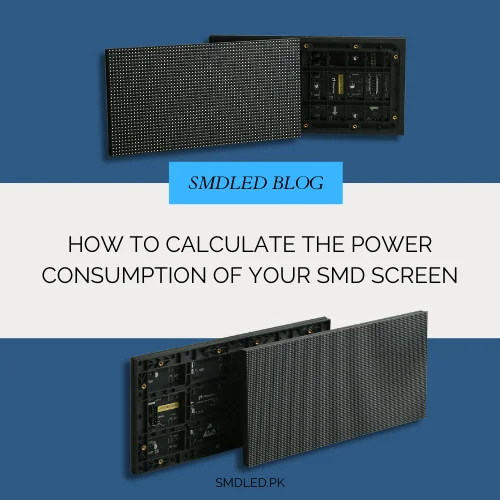
How to Calculate the Power Consumption of Your SMD Screen
One of the most overlooked yet critical aspects of LED display planning is SMD screen power consumption. Whether you are installing an indoor display, outdoor billboard, or large video wall, understanding power usage is essential for electrical safety, cost estimation, and uninterrupted performance.
This article provides a clear, step-by-step explanation of SMD screen power consumption, helping you calculate real electricity usage and plan power infrastructure correctly.
What Is SMD Screen Power Consumption
SMD screen power consumption refers to the amount of electrical energy an SMD LED screen uses during operation. It is typically measured in:
• Watts (W)
• Kilowatts (kW)
• Kilowatt-hours (kWh)
Power consumption depends on several technical and environmental factors.
Why Power Consumption Matters
Understanding SMD screen power consumption helps you:
• Plan electrical wiring and breakers
• Estimate monthly electricity cost
• Select suitable generators or UPS
• Avoid overheating and shutdowns
• Ensure legal and safety compliance
Ignoring power calculations can lead to system failure and unexpected expenses.
Key Factors Affecting SMD Screen Power Consumption
Several variables influence SMD screen power consumption.
Pixel Pitch
Smaller pixel pitch screens contain more LEDs per square meter and consume more power.
Brightness Level
Higher brightness settings increase power usage significantly.
Screen Size
Larger screens naturally consume more power.
Indoor vs Outdoor Use
Outdoor screens require higher brightness and therefore higher power.
Average Power Consumption per Square Meter
A practical way to estimate SMD screen power consumption is by square meter.
Typical values
• Indoor SMD screen: 200–350 W per square meter
• Outdoor SMD screen: 500–800 W per square meter
These are maximum values. Actual usage is often lower due to brightness control.
Explore indoor SMD solutions
https://smdled.pk/products/bia-indoor-smd-screen-module/
Explore outdoor SMD solutions
https://smdled.pk/products/bia-outdoor-smd-screen-module/
Step-by-Step Power Consumption Calculation
Let us calculate SMD screen power consumption using a simple example.
Example
Screen size: 10 square meters
Type: Outdoor SMD
Max power per square meter: 700 W
Calculation
10 × 700 W = 7000 W or 7 kW
This is the maximum power load.
Calculating Daily and Monthly Electricity Usage
To estimate cost, convert SMD screen power consumption into energy usage.
Example
7 kW running for 10 hours per day
Daily consumption
7 × 10 = 70 kWh
Monthly consumption
70 × 30 = 2100 kWh
Multiply by electricity tariff to calculate monthly cost.
Maximum vs Average Power Consumption
A common misunderstanding in SMD screen power consumption is maximum versus average usage.
Maximum power
• Occurs at 100 percent brightness
• Rarely used continuously
Average power
• Typically 40 to 60 percent of maximum
• Real-world operating value
Design power infrastructure for maximum load, but calculate cost using average consumption.
Power Consumption for Video Walls
Large video walls require careful SMD screen power consumption planning.
Video wall considerations
• High total wattage
• Load distribution
• Redundant power supplies
High-efficiency video wall solutions
https://smdled.pk/products/bia-hdr-4k-led-video-wall/
Indoor vs Outdoor Power Planning
Indoor screens
• Lower brightness
• Lower power requirement
• Standard electrical supply
Outdoor screens
• Higher brightness
• Dedicated power lines recommended
• Backup power essential
Understanding environment ensures safe operation.
Power Supply and Electrical Safety
Proper power supply design is critical for SMD screen power consumption management.
Best practices
• Use certified power supplies
• Avoid overloading circuits
• Proper earthing
• Surge protection
Electrical safety directly impacts screen lifespan.
Generator and UPS Sizing
For areas with power outages, SMD screen power consumption determines generator and UPS size.
Rule of thumb
• Generator capacity should exceed maximum screen load
• UPS should handle safe shutdown or short backup
Incorrect sizing can cause damage.
Energy Efficiency and Cost Optimization
Modern SMD screens are designed to reduce SMD screen power consumption.
Efficiency features
• Automatic brightness adjustment
• High-efficiency driver ICs
• Advanced power management
These features significantly reduce operating costs.
Common Power Consumption Mistakes
Mistakes related to SMD screen power consumption include
• Underestimating maximum load
• Using low-quality power supplies
• Ignoring heat dissipation
• No backup power planning
Avoiding these mistakes ensures long-term reliability.
Choosing Energy-Efficient SMD Screens
When selecting screens, ask about
• Power rating per square meter
• Brightness efficiency
• Power supply quality
Explore energy-efficient SMD screens
https://smdled.pk/products/
Get expert power planning support
https://smdled.pk/contact-us/
Industry installations and updates
https://www.facebook.com/Pksmdled
FAQs – SMD Screen Power Consumption
1. How much power does an SMD screen use
It depends on size, brightness, and pixel pitch.
2. What is average power consumption
Usually 40 to 60 percent of maximum rated power.
3. Do outdoor screens consume more power
Yes due to higher brightness requirements.
4. Can power consumption be reduced
Yes using automatic brightness control.
5. Is generator required for SMD screens
Recommended for outdoor and critical installations.
Call to Action
Understanding SMD screen power consumption helps you plan safely, reduce electricity costs, and avoid system failures. Proper power calculation is essential for reliable and long-term LED screen performance.
Explore energy-efficient SMD screens
https://smdled.pk/
Browse products
https://smdled.pk/products/
Get expert power planning
https://smdled.pk/contact-us/
Follow installations and updates
https://www.facebook.com/Pksmdled