
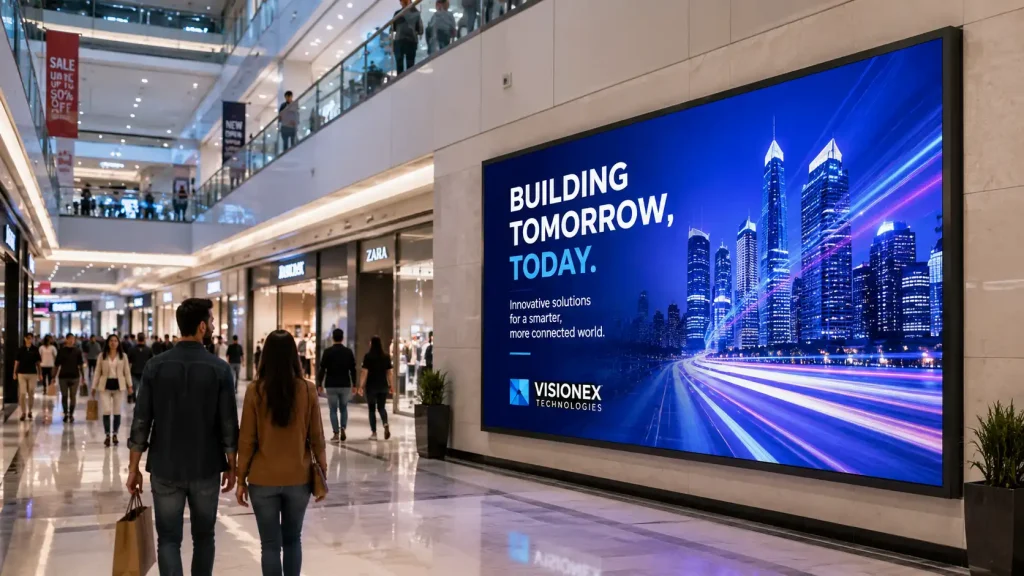
A high resolution indoor SMD screen replaces printed panels, projectors and tiled LCD walls with one continuous surface. Retailers, banks, hotels and corporate offices across Lahore, Karachi and Islamabad now specify pixel pitches between 1.25 mm and 2.5 mm for interiors where customers stand within three metres of the display. The investment case rests on four measurable factors: content flexibility, running cost, service life and attention capture. This guide sets out the specifications that matter, the applications they suit, and the cost model that decides whether the purchase pays back.
What Defines a High Resolution Indoor SMD Screen
SMD packaging places red, green and blue diodes inside a single lamp housing. Tighter packaging shortens pixel pitch, which raises resolution per square metre. Indoor modules run lower brightness than outdoor units because interior ambient light is controlled, and that lower output extends lamp life while cutting power draw.
Pixel Pitch and the Viewing Distance Rule
The working rule is direct: minimum comfortable viewing distance in metres roughly equals pixel pitch in millimetres. Optimal viewing sits at two to three times that figure. Specify pitch from where people actually stand, not from a catalogue.
| Pixel pitch | Minimum viewing distance | Native resolution on a 3 m x 2 m screen | Typical application |
| 1.25 mm | 1.25 m | 2400 x 1600 | Control rooms, broadcast sets, trading floors |
| 1.538 mm | 1.5 m | 1950 x 1300 | Boardrooms, bank branch interiors |
| 1.86 mm | 1.9 m | 1612 x 1075 | Showroom walls, reception features |
| 2 mm | 2 m | 1500 x 1000 | Corporate lobbies, clinic waiting areas |
| 2.5 mm | 2.5 m | 1200 x 800 | Retail floors, mall atriums |
| 3 mm | 3 m | 1000 x 666 | Banquet halls, auditoriums |
| 4 mm | 4 m | 750 x 500 | Warehouses, sports halls, large canteens |
Brightness, Contrast, Refresh and Uniformity
Indoor modules deliver 450 to 600 nits, which reads correctly under retail and office lighting without glare. Contrast at 5000:1 holds text edges. Refresh rates from 1920 Hz to 3840 Hz decide how the screen behaves on camera, and 3840 Hz is the figure to insist on wherever content is filmed or photographed. Colour gamut of 100 percent NTSC or above, brightness uniformity at 97 percent or better, and pixel by pixel correction applied at the factory keep the surface visually even. Viewing angles of 160 degrees horizontal and 140 degrees vertical matter in narrow showrooms where customers approach from the side. Rated lamp life reaches 100,000 hours.
Core Applications Across Pakistani Industries
Retail and Shopping Malls
Retail uses the screen as changeable inventory. Price drops, new arrivals and promotions load in minutes instead of waiting on a print run. A 2.5 mm wall behind the till or above the entrance serves both in store shoppers and mall traffic. Multi tenant malls sell loop slots to brands and convert the fixture into a revenue line.
Corporate Offices, Banks and Control Rooms
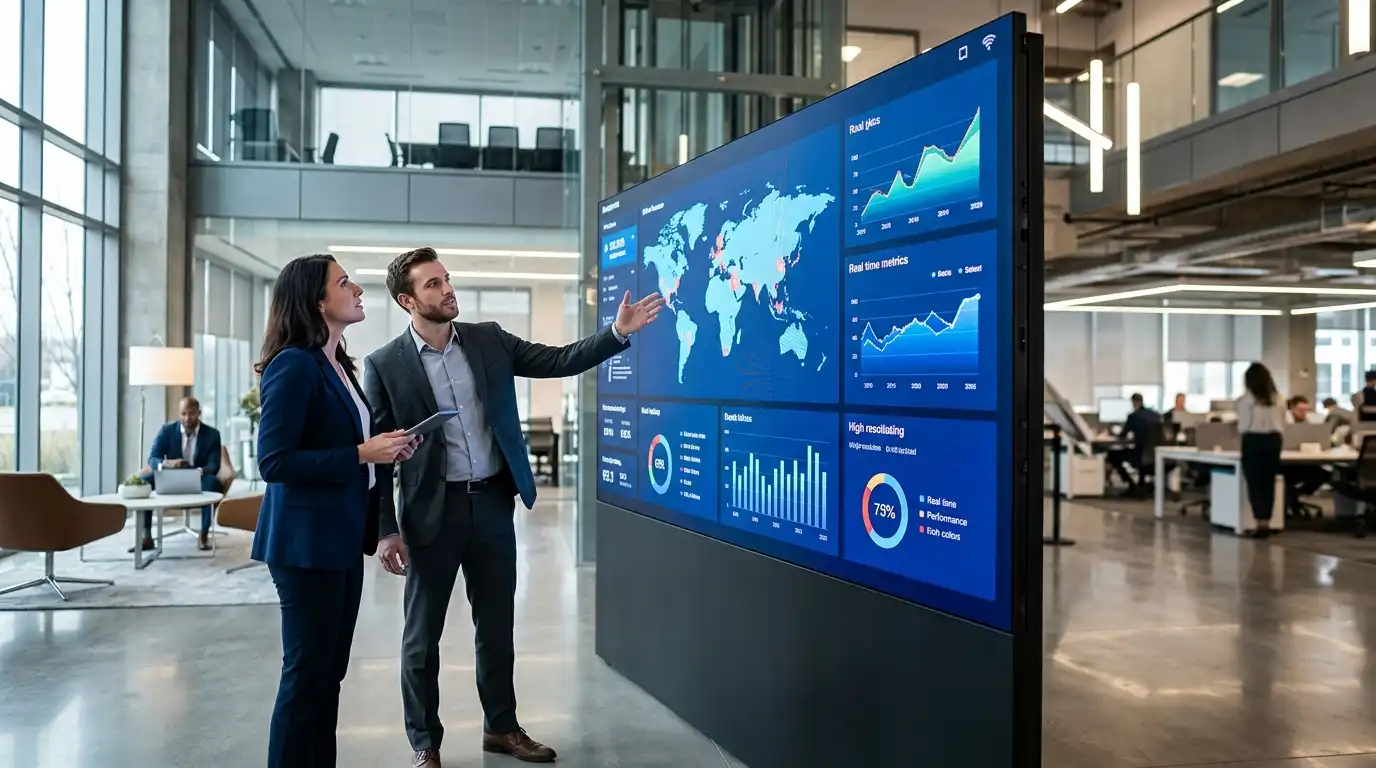
Lobbies run brand films, safety statistics and visitor welcome content. Bank branches display rates, queue information and product messaging. Control rooms need the tightest pitches, because operators sit within two metres of the surface and read dense data continuously. For those positions a fine pitch HDR 4K LED video wall at 0.945 mm to 1.89 mm holds text legibility that a 2.5 mm module cannot.
Hospitality, Education and Healthcare
Hotels run event wayfinding and banquet branding on the same surface across a single day. Universities use auditorium walls for lectures and convocations. Hospitals display department directories and queue tokens. Where the display doubles as a conference backdrop, review our guide to indoor SMD screens for events and conferences in Pakistan.
Specification to Application Matching
| Business scenario | Viewer distance | Recommended pitch | Screen size guide | Priority feature |
| Retail checkout wall | 1.5 to 3 m | 1.86 to 2.5 mm | 2.5 m x 1.5 m | Front maintenance access |
| Bank branch interior | 2 to 4 m | 1.538 to 2 mm | 2 m x 1.2 m | Colour accuracy for brand identity |
| Corporate reception | 3 to 6 m | 2 to 2.5 mm | 3 m x 2 m | Slim depth for wall recess |
| Control room | 1 to 2 m | 0.945 to 1.538 mm | 4 m x 2.25 m | Greyscale depth and redundancy |
| Auditorium or banquet hall | 6 to 20 m | 2.5 to 3 mm | 5 m x 3 m | 3840 Hz refresh for camera work |
| Showroom feature wall | 2 to 5 m | 1.86 to 2.5 mm | 3 m x 1.8 m | Viewing angle from the side |
Lahore Infrastructure and Environmental Factors
At SMDLED, we see these factors influence local project planning.
| Factor | Local condition | Specification response |
| Supply voltage | 230 V nominal with regular sag and surge | Servo stabiliser feeding the power supply rack |
| Supply interruption | Changeover to generator often exceeds 10 seconds | Online UPS on the processor and receiving cards to avoid a reboot mid campaign |
| Summer heat | Interiors pass 35 C when cooling lags footfall | Modules rated to 40 C, rear clearance of 300 mm, lamp surface held below 60 C |
| Smog season | October to January raises airborne particulate | Quarterly dry cleaning of module faces; filter maintenance on the HVAC intake |
| Monsoon humidity | July to mid September | Store spare modules sealed with desiccant; check for condensation on cold surfaces |
| Electricity tariff | Commercial rates near Rs 44 per unit | Compare average W per square metre between quotations, not just capital price |
| Spare part lead time | Non standard SKUs import slowly | Order 3 to 5 percent spares in the original production batch |
Total Cost of Ownership Against the Alternatives
Start with electricity, because it is the line most quotations omit. Indoor SMD modules average 40 to 155 W per square metre, with peaks near 460 W on full white frames. A 3 m by 2 m screen covers 6 square metres. At an average of 150 W per square metre it draws 0.9 kW. Running 12 hours a day for 30 days consumes roughly 324 units, which is close to Rs 14,250 a month at commercial tariffs. Designing content with darker backgrounds pulls the average down materially, because power tracks lit pixels.
| Cost line | Printed backlit panel | Tiled LCD video wall | Indoor SMD screen |
| Creative change | Reprint and reinstall each time | File upload | File upload |
| Visible seams | None, but static | Bezel grid across every frame | Continuous surface, no bezels |
| Brightness | Depends on backlight condition | Drops over panel life | 450 to 600 nits with correction |
| Rated life | 12 to 24 months before fade | Around 50,000 hours | 100,000 hours |
| Repair unit | Full reprint | Whole panel replacement | Single module swap |
| Warranty position | None after installation | Panel level | Commonly four years on indoor modules |
Payback calculation. Total your current annual spend on printed panels, design charges and installation labour. Add the value of promotions you cannot run because print turnaround is too slow. Divide the installed screen cost by that annual figure to get payback in years. Retailers running weekly promotions usually reach payback fastest, and the mechanism behind that lift is explained in how SMD screens improve digital advertising performance.
Purchasing Checklist Before You Sign
- Pixel pitch selected from measured viewing distance, with the native resolution of the finished screen stated in writing.
- Brightness, contrast, refresh rate and colour temperature range listed on the quotation.
- Average and maximum W per square metre disclosed for the electricity calculation.
- Single production batch confirmed, with 3 to 5 percent spares included.
- Factory brightness correction file supplied at handover.
- Front maintenance access where the screen mounts against a wall.
- Warranty duration, exclusions and response time named in the document.
- Stabiliser, UPS and power distribution included in the scope, not assumed.
Match the product family to the room before comparing prices. Interior projects run through our SMDLED indoor SMD screen solutions, with hardware options across the indoor SMD screen module range covering 1.25 mm to 4 mm pitch, and the ultra thin SMD screen module where wall depth is restricted.
Specify From the Room, Not the Catalogue
Four inputs decide the correct screen: where viewers stand, how bright the room is, how many hours a day it runs, and whether cameras will film it. Send those four and the specification follows. Compare configurations in the full indoor display catalogue, then request a site survey and itemised quotation from our SMDLED Lahore engineering team. We measure the space, size the electrical supply, install and commission the screen, and hand over a documented maintenance schedule with local spare stock behind it.