
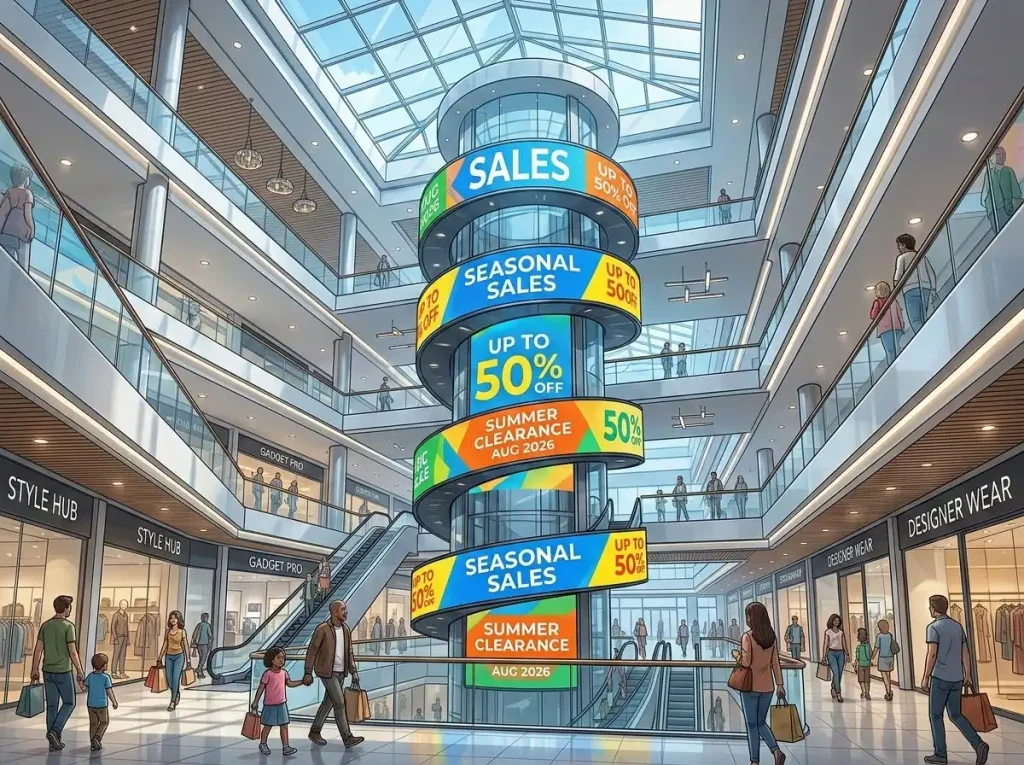
A shopping mall is never just one advertising environment. A visitor may notice a brand message when entering through the main doors, encounter another promotion while walking through an atrium, see a restaurant campaign near the food court, and discover a seasonal offer while waiting near an escalator.
For mall operators and advertisers, this creates an opportunity to communicate with shoppers at multiple points throughout their visit.
LED video walls make these spaces more flexible by replacing fixed promotional surfaces with large digital canvases that can display videos, animations, branding, announcements, and changing campaigns. Instead of relying on one permanent message, shopping centers can use the same display infrastructure for different advertising purposes throughout the day.
Start at the Entrance
The first few moments inside a shopping center can establish its visual atmosphere.
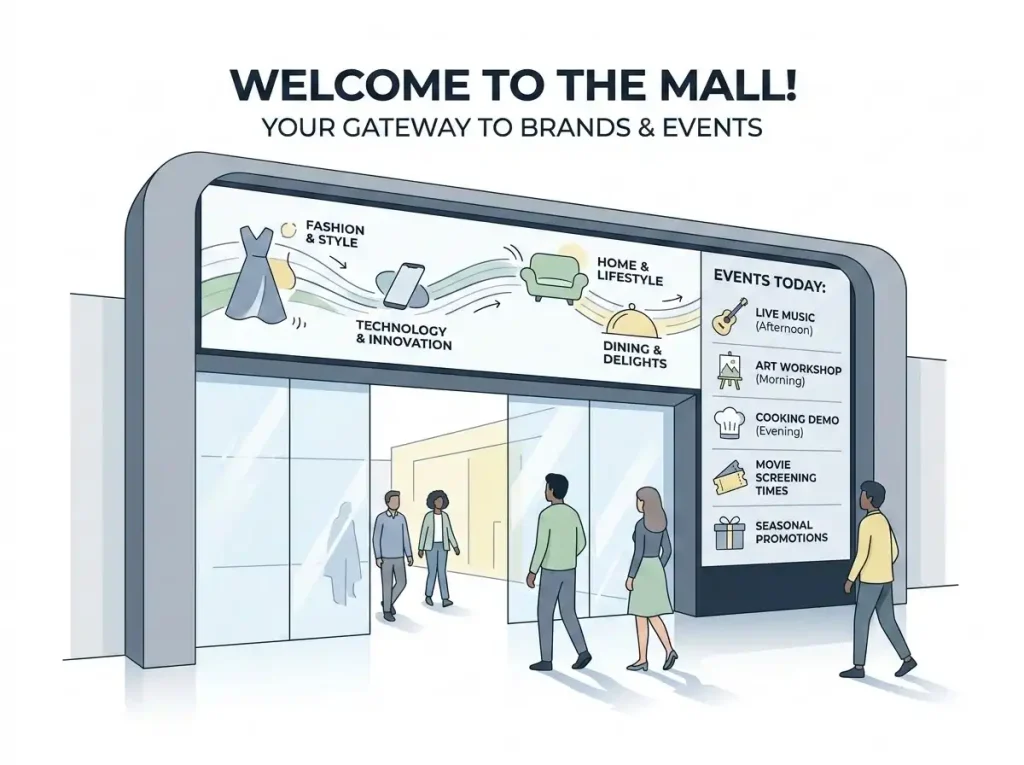
Large LED displays positioned near entrances can welcome visitors, promote major retailers, announce upcoming events, or introduce seasonal campaigns. Because the content is digital, the display can change according to the mall’s current priorities instead of remaining tied to one printed message.
For example, a mall could use its entrance display for:
- A weekend shopping campaign
- A new-store announcement
- A holiday promotion
- An upcoming entertainment event
- Corporate or mall-wide branding
This makes the entrance more than a transition point. It can become an active communication zone.
Turn the Atrium Into a Campaign Space
Large atriums offer something advertisers cannot easily achieve with conventional posters: scale.
A strategically positioned LED video wall can become a visual centerpiece visible from different levels of the building. Retail brands can use the space for product launches, fashion campaigns, seasonal promotions, or larger brand stories.
The large digital canvas also creates opportunities for campaigns that depend on movement. Video footage, animated graphics, and changing visuals can help a campaign feel more integrated into the environment rather than appearing as another sign attached to a wall.
Keep the Message Moving Through the Mall
A visitor does not remain in one part of a shopping center.
They move between entrances, stores, escalators, food courts, entertainment areas, and waiting spaces. This movement allows mall operators to use different displays for different communication goals.
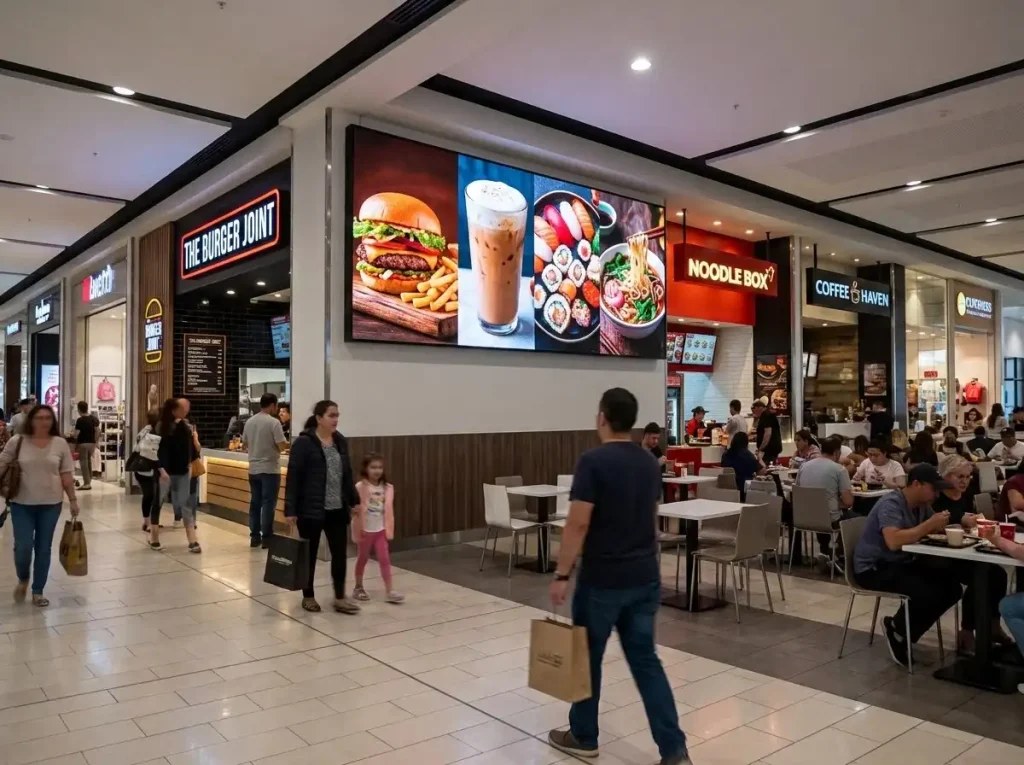
A screen near an escalator might promote a nearby retailer. A display in a food court could highlight restaurant offers. Another screen near a central walkway could carry several tenant campaigns throughout the day.
This creates a network of digital advertising opportunities rather than one isolated billboard.
One Display Can Serve Many Advertisers
Another practical advantage is the ability to rotate content.
A mall operator does not necessarily have to dedicate an entire screen to one brand. Multiple advertisers can share scheduled content slots, with different campaigns appearing throughout the day.
This can support:
Retail promotions: highlighting discounts, launches, and store-specific offers.
Food and beverage campaigns: promoting restaurants, cafes, and limited-time deals.
Entertainment advertising: promoting cinema releases, family activities, or special events.
Seasonal campaigns: supporting Eid, holiday shopping, back-to-school promotions, or mall-wide sales.
Mall communications: sharing announcements, event information, or visitor guidance.
The same digital infrastructure can therefore support both commercial advertising and the mall’s own communication needs.
Make Different Times of Day Work Differently
A major advantage of programmable digital displays is that campaigns do not have to remain identical from morning until closing.
A shopping center can organize content around its daily traffic patterns and promotional priorities. Morning messaging may differ from afternoon retail campaigns, while evening content can focus on restaurants, entertainment, or special events.
This also makes it easier to respond to short-term opportunities.
A tenant launching a flash sale does not necessarily need to wait for a new physical banner to be printed and installed. The campaign can be incorporated into the digital content schedule instead.
The Display Should Match the Shopper’s Distance
A large screen inside a mall is not automatically suitable for every location.
Displays positioned along a close pedestrian route need to present text and imagery clearly at shorter distances. A large atrium wall viewed from across several floors may require a different configuration.
This is where pixel pitch becomes important. The appropriate pitch should be selected according to how close shoppers are expected to stand and how detailed the content needs to appear.
Brightness also needs to be considered, particularly in atriums with large skylights or strong artificial lighting. The goal is clear, comfortable visibility rather than simply choosing the highest possible brightness.
Refresh rate, resolution, viewing angle, power requirements, and service access should also be considered as part of the overall system design.
Think About What Shoppers Will Actually See
A technically impressive screen can still deliver a weak advertising experience if its content is poorly suited to the environment.
Mall audiences are usually moving. Some shoppers may only glance at a display for a few seconds, while others may remain nearby for longer periods.
Content should therefore communicate the main idea quickly.
Strong branding, recognizable imagery, concise messaging, and appropriately sized text can make campaigns easier to understand while people are walking through busy retail spaces. Video can then add movement and storytelling without making the message unnecessarily complicated.
The screen should support the campaign rather than overwhelm it.
A Better Way to Plan Screen Locations
Rather than installing displays wherever wall space is available, mall operators can consider how visitors naturally move through the property.
A useful placement strategy may include:
Entrance zones for high-visibility welcome and promotional messaging.
Central atriums for major brand campaigns and large-scale visual experiences.
Escalator areas for repeated exposure as visitors move between floors.
Food courts for restaurant and dining promotions.
Retail corridors for tenant advertising and nearby offers.
Entertainment zones for event, cinema, and activity-related content.
The ideal placement depends on the mall’s layout, sightlines, lighting, visitor movement, and available structural space.
What the Mall Operator Needs to Plan
Before installation begins, several practical details need to be settled.
The available wall area should be measured carefully, while structural capacity should be reviewed for the proposed installation. Viewing distances and angles can then help determine the display configuration.
Content management also deserves attention. Mall operators should establish who will upload campaigns, how advertising slots will be scheduled, and how different tenants will share available screen time.
Maintenance access should be considered at the design stage as well. A display installed in a difficult-to-reach location can create unnecessary servicing challenges later.
Good planning therefore covers both the physical installation and the way the screen will actually be operated.
From Advertising Screen to Mall Experience
The most valuable role of an LED video wall may be its ability to contribute to the overall atmosphere of a shopping center.
A large digital display can support a product launch one day, a seasonal campaign the next, and a mall event after that. It can help fill an otherwise plain architectural surface while giving advertisers a flexible platform for visual storytelling.
For mall operators, this creates a communication tool that can evolve with changing tenants, campaigns, events, and visitor expectations.
Give Shoppers Something More to Look At
Shopping mall advertising does not have to compete through more printed signs.
LED video walls give retail environments a flexible way to introduce motion, scale, changing content, and multiple advertising opportunities throughout the customer journey. When the display size, content, location, and operating strategy are planned together, the technology can become a useful part of both the mall’s advertising infrastructure and its visual environment.
SMD LED provides commercial digital display solutions for shopping malls, retail environments, and other businesses across Pakistan. Our team can help plan an LED video wall around your available space, viewing conditions, and advertising objectives.
Looking to introduce a large-format digital display in your shopping mall? Contact SMD LED to discuss your installation requirements.
Frequently Asked Questions
What is an LED video wall?
An LED video wall combines multiple modular LED display panels into a single continuous canvas. This modular setup creates massive screens of any custom size without visible image borders.
How do shopping malls benefit from digital advertising screens?
Digital screens eliminate recurring printing expenses and allow instant campaign updates. Malls also generate extra revenue by renting ad space to multiple third-party brands.
Can indoor retail displays operate continuously every day?
Yes, commercial-grade panels feature robust thermal management built for continuous 24/7 operation. High-quality components prevent overheating during peak shopping seasons.
What pixel pitch is ideal for indoor shopping malls?
Indoor spaces require tighter pixel pitches, typically between 1.2mm and 2.5mm. Closer viewing ranges demand higher resolutions to keep advertisements sharp and legible.
Why is professional technical installation necessary?
Certified technicians ensure secure structural mounting and precise electrical connections. Professional setup prevents signal loss and maintains long-term hardware reliability.