
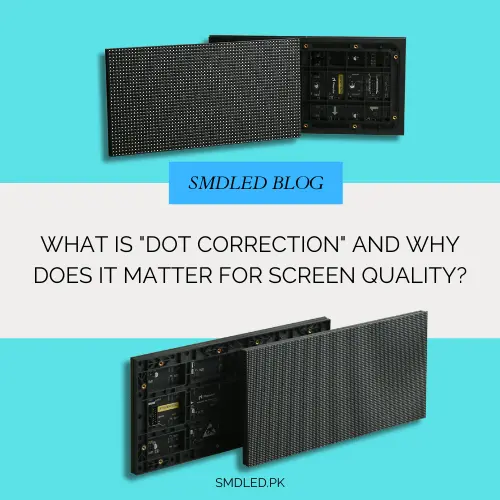
What is “Dot Correction” and Why Does it Matter for Screen Quality?
In the rapidly expanding world of digital displays, buyers across Pakistan are constantly seeking the sharpest, brightest, and most impactful SMD screens available. During the purchasing journey, you will encounter heavily marketed specifications like pixel pitch, refresh rate, and grayscale. While those are undeniably crucial, they mean absolutely nothing if the screen suffers from the “dirty window” effect—a blotchy, uneven appearance that ruins the visual experience.
The industry’s definitive cure for this issue is an advanced technological process known as Dot Correction.
Whether you are deploying a towering outdoor billboard along a bustling highway or integrating a cinematic video wall into a high-end corporate auditorium, Dot Correction is the invisible shield protecting your visual investment. Without Dot Correction, an LED display will inevitably reveal the raw, unpolished inconsistencies of its microscopic components.
In this comprehensive exploration, we will dissect the optical engineering behind Dot Correction. We will uncover why LED diodes inherently lack uniformity, how the intricate mathematics of Dot Correction solves this problem, and why securing products that feature robust Dot Correction capabilities is mandatory for achieving world-class visual performance.
The Core Problem: Why LED Screens Lose Uniformity
To truly appreciate the power of Dot Correction, you must first understand why the problem exists. Many buyers assume that when a factory produces a batch of blue LED diodes, every single one of those diodes emits the exact same shade of blue at the exact same brightness.
This assumption is completely false.
The manufacturing of light-emitting diodes is an incredibly complex semiconductor process. Despite billions of dollars in factory automation, it is physically impossible to produce identical diodes. There will always be microscopic variations in the chemical composition of the semiconductor wafers. These tiny variations cause fluctuations in two critical areas:
- Luminance (Brightness): One red diode might shine at 1,000 nits, while the red diode right next to it shines at 950 nits.
- Chrominance (Color Wavelength): One green diode might emit light at a 520-nanometer wavelength, while its neighbor emits at 525 nanometers, making it look slightly more yellow.
When factories produce SMD LED products, they attempt to group similar diodes together in a process called “binning.” However, binning is never perfect. When millions of these slightly varied diodes are packed together to form a massive screen, the human eye instantly detects the inconsistencies. The screen looks grainy, textured, or patchy.
Furthermore, as screens age, diodes degrade at different rates based on heat and usage. Over the years, a once-perfect screen will naturally become uneven. This is exactly where the technological brilliance of Dot Correction steps in to save the day.
What Exactly is Dot Correction?
In technical terms, Dot Correction is a sophisticated calibration technology that adjusts the individual light output and color output of every single pixel on an LED display.
Instead of treating the LED screen as one giant, uncontrollable lightbulb, a Dot Correction system treats the screen as a grid of millions of independent micro-lights. The primary objective of Dot Correction is to force all of these independent lights to behave identically, creating a perfectly smooth, uniform canvas.
Think of an orchestra with a thousand musicians. Without a conductor, each musician plays at their own volume and slightly out of tune. The result is chaotic noise. Dot Correction acts as the master conductor. It listens to every single musician, tells the loud ones to play softer, tells the flat ones to adjust their pitch, and ensures the entire orchestra produces a single, harmonious symphony.
To achieve this, the Dot Correction process relies heavily on the screen’s receiving cards and control system. High-end display modules like the BIA Indoor SMD Screen Module contain advanced integrated circuits capable of storing and executing the vast mathematical coefficients required for Dot Correction in real-time.
How Dot Correction Works: The Technical Process
Applying Dot Correction is not a simple press of a button. It is a highly scientific procedure that combines specialized optical cameras, advanced software algorithms, and real-time hardware adjustments.
The Dot Correction procedure generally follows three distinct phases:
Phase 1: Optical Measurement
The Dot Correction process begins with precise measurement. A specialized, ultra-high-resolution photometric camera is placed in front of the LED screen in a dark environment. The screen is commanded to display pure red, pure green, pure blue, and pure white.
The camera captures the exact luminance (brightness) and chrominance (color) of every single pixel on the screen. This data is fed into the Dot Correction software, creating a massive digital map of the screen’s inconsistencies. The software now knows exactly which pixels are too bright, too dim, or slightly off-color.
Phase 2: Data Processing and Coefficient Generation
Once the software has the optical map, the mathematical heart of the Dot Correction process begins. The software determines a “target value” for the screen. This target value is typically aligned with the darkest and least saturated pixel in the batch, because you can always reduce the brightness of a strong pixel, but you cannot force a weak pixel to exceed its maximum capacity.
The software generates a unique mathematical coefficient for every individual diode. For instance, the calibration coefficient $C_i$ for a specific pixel’s brightness is calculated as $C_i = \frac{T}{M_i}$, where $T$ is the universal target brightness and $M_i$ is the measured brightness of that specific pixel. This precise calculation is the bedrock of Dot Correction.
Phase 3: Real-Time Hardware Adjustment
Finally, these millions of unique coefficients are uploaded directly to the receiving cards embedded inside the LED cabinets. As video data flows into the screen, the receiving cards apply the Dot Correction coefficients to the video feed in real-time before the signal hits the diodes.
Because the hardware applies these Dot Correction coefficients instantaneously, the viewer sees a perfectly uniform image without any delay or lag in the video playback.
Brightness Dot Correction vs. Color Dot Correction
When evaluating display specifications, you will often see Dot Correction split into two distinct categories. Understanding the difference between these two types of Dot Correction is vital for ensuring your screen meets your visual standards.
| Feature | Brightness Dot Correction | Color (Chroma) Dot Correction |
| Primary Goal | Ensures uniform light intensity across the entire screen. | Ensures uniform color wavelengths (pure RGB) across the screen. |
| Visual Result | Eliminates patchy, “cloudy,” or textured appearances. | Eliminates color shifting, ensuring pure whites and accurate brand colors. |
| Complexity | Mathematically simpler; requires fewer hardware resources. | Highly complex; requires premium driver ICs to alter color mixing. |
| Application | Standard for almost all modern, high-quality outdoor and indoor displays. | Reserved for high-end professional displays, virtual production, and broadcast. |
For standard outdoor advertising, brightness Dot Correction is usually sufficient to achieve an excellent image from a distance. However, for elite applications like the BIA HDR 4K LED Video Wall, employing full-color Dot Correction is absolutely critical to guarantee that high-definition content renders with cinematic, photorealistic accuracy.
Why Dot Correction is Critical for Different Applications
The necessity of Dot Correction scales depending on how and where the screen is utilized. Let us examine how Dot Correction impacts different deployment environments across the digital signage landscape.
1. Broadcast and Virtual Production
In a television studio, the cameras are merciless. Professional broadcast cameras will instantly magnify any screen inconsistency that the naked eye might miss. If a news anchor is standing in front of a video wall that lacks Dot Correction, the background will look heavily pixelated and distracting on television. Full color and brightness Dot Correction ensures the background looks like a seamless physical set, rather than a giant electronic grid.
2. Corporate Lobbies and Control Rooms
When a multinational corporation installs a massive screen in their headquarters, they demand perfection. These screens often display complex data visualizations, expansive spreadsheets, or the company’s highly specific brand colors. Without Dot Correction, a solid block of corporate blue might look like a patchwork quilt of navy and cyan. Dot Correction guarantees that brand identities are represented accurately and data is legible without visual interference.
3. Outdoor Advertising and Retail Billboards
While outdoor screens are viewed from farther away, they suffer the most environmental abuse. Over the span of a few years, direct sunlight and extreme heat will cause outdoor LEDs to degrade at wildly different rates. A screen that looked great on day one might look terrible by year three. Applying an on-site Dot Correction recalibration to products like the BIA Outdoor SMD Screen Module can instantly strip away years of visual aging, restoring the billboard to a uniform, factory-fresh appearance.
The Financial Impact of Dot Correction
Many buyers view Dot Correction purely as an aesthetic luxury. In reality, demanding a display system with robust Dot Correction capabilities is a highly strategic financial decision.
“Investing in a screen with advanced Dot Correction hardware does not just improve the image; it actively extends the profitable lifespan of your digital asset.”
When an aging screen begins to look patchy and unreadable, businesses often assume the hardware is dead and needs to be completely replaced—costing millions of rupees. However, the physical diodes are rarely dead; they are simply out of sync.
By utilizing the Dot Correction process, technicians can remeasure the degraded screen, generate fresh coefficients, and lower the overall target brightness to match the weakest aged pixels. This secondary Dot Correction application effectively masks the aging process, squeezing several more years of high-quality operational life out of the hardware before a replacement is truly necessary. Therefore, Dot Correction directly improves your long-term Return on Investment (ROI).
Common Misconceptions About Dot Correction
Because Dot Correction involves complex optical science, several myths have circulated within the digital signage industry. It is important to clear the air.
- Myth 1: Dot Correction can fix dead pixels. This is entirely false. Dot Correction relies on manipulating the light emitted by working diodes. If a diode is physically broken or burned out, Dot Correction cannot magically make it light up. The module must be physically repaired first.
- Myth 2: Dot Correction makes the screen brighter.The opposite is actually true. Because Dot Correction relies on achieving uniformity, it mathematically forces the brightest, strongest pixels to lower their output to match the weaker pixels. Therefore, applying Dot Correction slightly reduces the maximum peak brightness of the screen in exchange for achieving perfect uniformity.
- Myth 3: Any software can perform Dot Correction.Dot Correction requires deep hardware integration. The LED cabinets must contain receiving cards and driver ICs equipped with enough memory to store the massive coefficient maps. If you buy cheap, low-tier hardware, it physically cannot support the data required for true Dot Correction.
Conclusion: Achieving Visual Perfection
In the modern era of ultra-high-definition content, simply blasting bright light from a wall is no longer sufficient. Audiences expect seamless, immersive, and flawless visual experiences. The only way to bridge the gap between the chaotic limitations of semiconductor manufacturing and the demand for visual perfection is through the rigorous application of Dot Correction.
By digitally enforcing strict uniformity across millions of individual pixels, Dot Correction transforms a massive grid of electronics into a singular, breathtaking digital canvas. When evaluating your next display investment, do not merely ask about the pixel count or the physical dimensions. Demand to know the hardware’s Dot Correction capabilities, and secure a system that guarantees flawless performance from the very first frame to the final year of its operational life.
Frequently Asked Questions (FAQs)
1. What is Dot Correction in LED screens?
Dot Correction is an advanced calibration technology used to precisely adjust the brightness and color output of each individual LED pixel on a display. This ensures the entire screen looks completely uniform, smooth, and free of patchy inconsistencies.
2. Why do brand-new LED screens need Dot Correction?
Due to the microscopic limitations of semiconductor manufacturing, no two LED diodes are created exactly identical in brightness and color wavelength. Dot Correction mathematically compensates for these inherent physical differences before the screen ever leaves the factory.
3. What is the difference between brightness Dot Correction and color Dot Correction?
Brightness Dot Correction only adjusts the luminance intensity of the pixels to ensure the screen is evenly lit. Color Dot Correction goes a step further by adjusting the specific color wavelengths of each pixel, ensuring perfect chromatic uniformity and pure color reproduction.
4. Does Dot Correction fix dead pixels?
No. Dot Correction cannot fix a physically dead, shattered, or burned-out LED diode. It only recalibrates functional, working pixels to match a unified target standard across the display. Dead pixels require physical module repair or replacement.
5. How often should Dot Correction be performed?
It is typically performed once at the factory prior to shipping. However, as outdoor screens age and degrade unevenly over years of usage, a secondary on-site Dot Correction calibration can be performed by technicians to completely restore the display’s original uniform quality.
Secure Premium Display Hardware Today
Achieving a flawless, unified image requires investing in professional-grade hardware engineered with cutting-edge calibration technology. At SMD LED, we supply a comprehensive range of top-tier displays featuring advanced processing architectures designed to support high-level uniformity and reliability.
Explore our extensive catalog of professional SMD LED products to find the exact hardware specifications required for your environment. Ready to purchase your next display? Visit our Contact Us page to secure your premium digital signage directly from our team, and be sure to Follow us on Facebook for the latest product releases across Pakistan.