
In the rapidly evolving landscape of event management and digital entertainment in Pakistan, physical venue capacity is no longer the ultimate limit to your audience size. Whether you are hosting a massive corporate summit in Lahore, an intense e-sports tournament in Karachi, or a beautiful, sprawling wedding in Islamabad, there is a profound need to broadcast the action in real-time to everyone present. The absolute most effective way to achieve this unparalleled level of visual engagement is to flawlessly live-stream to your SMD LED Screen.
When you choose to live-stream to your SMD LED Screen, you instantly elevate a standard, static event into a deeply immersive, highly dynamic visual spectacle. Instead of attendees struggling to see a distant speaker or a tiny stage performance, a massive, brilliantly glowing digital canvas provides every single person with a flawless, front-row experience. However, successfully executing a live broadcast is a highly complex technical endeavor. It requires far more than simply plugging a camera directly into a display. If you want to professionally live-stream to your SMD LED Screen without suffering from embarrassing video lag, distorted audio, or catastrophic signal drops, you must thoroughly understand the intricate web of hardware and software involved.
In this comprehensive, world-class technical guide, we will deeply explore the precise architecture required to perfectly live-stream to your SMD LED Screen. We will aggressively break down the essential camera hardware, dissect the required networking infrastructure, review the best broadcasting software, and explain exactly how to select the absolute best display modules to guarantee that your real-time visual production is a total, undeniable success.
1. The Fundamental Architecture of Live Broadcasting
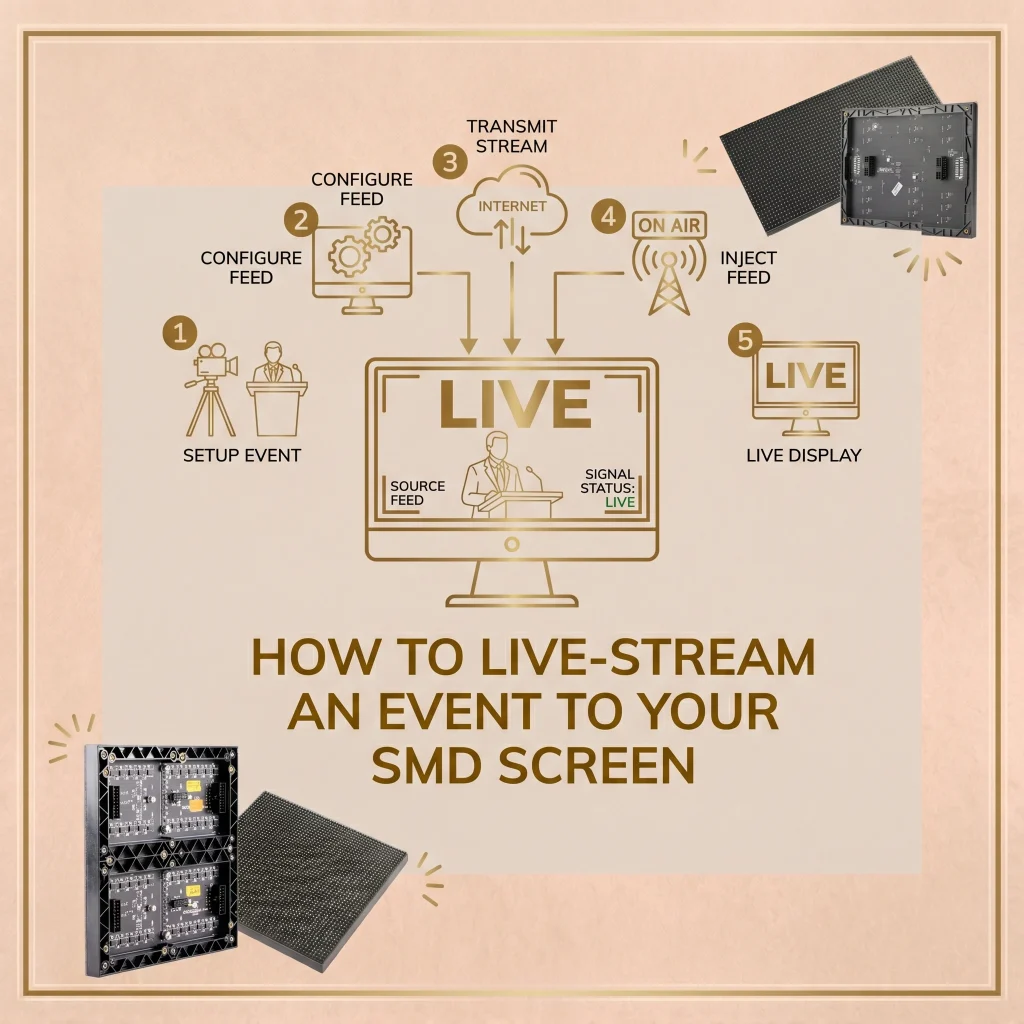
To truly understand how to properly live-stream to your SMD LED Screen, you must first comprehend the critical signal flow. The journey of the visual data begins at the physical camera lens and must travel through several highly sophisticated electronic processing checkpoints before it finally illuminates the massive display. If any single link in this critical chain is weak, the entire attempt to live-stream to your SMD LED Screen will severely degrade.
The standard operational workflow to live-stream to your SMD LED Screen involves four distinct, non-negotiable stages: First, the live action is captured by high-definition cameras. Second, that raw video signal is securely transmitted via heavy-duty cables to a central production switcher or capture card. Third, specialized broadcasting software digitally processes, encodes, and formats that live feed. Finally, the processed signal is sent directly into an advanced video processor, which flawlessly maps the massive video file directly onto the millions of individual diodes of your display.
Mastering this specific, highly sequential workflow is absolutely mandatory. Whether you are attempting to live-stream to your SMD LED Screen for a small, highly intimate corporate seminar or a colossal, stadium-sized political rally, the fundamental physics of the signal routing remain exactly the same.
2. Capturing the Action: Essential Camera Hardware
The absolute first step to beautifully live-stream to your SMD LED Screen is capturing a pristine, high-resolution source image. If you feed a blurry, low-quality video signal into a massive, ultra-high-definition display, the massive screen will only magnify those terrible visual flaws. Therefore, you absolutely cannot rely on cheap webcams or standard smartphone cameras to professionally live-stream to your SMD LED Screen.
For professional event broadcasting, you must utilize high-end DSLR cameras, dedicated mirrorless videography rigs, or highly advanced PTZ (Pan-Tilt-Zoom) robotic cameras. When you use these premium devices to live-stream to your SMD LED Screen, you gain absolute, granular control over critical visual elements like optical zoom, precise focal depth, and heavy exposure balancing. This ensures that even in a highly dynamic, wildly shifting lighting environment—such as a dark concert stage violently illuminated by massive laser strobes—the image you live-stream to your SMD LED Screen remains flawlessly crisp and beautifully balanced.
Furthermore, these professional cameras output their raw, uncompressed video signals through highly secure HDMI or heavy-duty SDI (Serial Digital Interface) ports. For massive arenas where the camera operator is standing hundreds of feet away from the central control room, utilizing thick, locking SDI cables is strictly required to reliably live-stream to your SMD LED Screen without suffering from severe signal degradation or complete video blackouts over massive physical distances.
3. The Digital Bridge: Capture Cards and Switchers
Once your high-end cameras have captured the raw footage, that heavy data must be aggressively ingested into your central broadcasting computer. Standard computer motherboards simply cannot process raw, uncompressed HDMI or SDI video feeds natively. To successfully bridge this gap and live-stream to your SMD LED Screen, you must utilize premium hardware capture cards or highly advanced live production switchers.
A capture card acts as the vital digital translator. It takes the heavy, uncompressed video signal from the camera and instantly, with zero latency, converts it into a digital format that your broadcasting software can rapidly manipulate. If you plan to use multiple different camera angles to heavily dynamically live-stream to your SMD LED Screen, you will absolutely require a massive, multi-channel PCIe capture card installed directly into a heavy-duty, highly customized desktop workstation.
Alternatively, many professional event organizers utilize external hardware switchers, such as the renowned Blackmagic ATEM series. These powerful, tactile devices allow a technical director to seamlessly cut between four or eight different live camera feeds instantly. Using a dedicated hardware switcher to live-stream to your SMD LED Screen ensures that the visual transitions are incredibly smooth, highly cinematic, and completely free from the highly distracting, laggy stuttering often associated with severely underpowered laptop setups.
4. Software Solutions for a Flawless Broadcast
The physical hardware acts as the heavy muscle, but the broadcasting software is the absolute, highly intelligent brain of your entire operation. To professionally live-stream to your SMD LED Screen, you must utilize robust, highly stable live production software. Standard video players like VLC are completely incapable of handling the highly complex, real-time routing required to properly live-stream to your SMD LED Screen.
The absolute industry standard for highly professional, flawless software broadcasting is OBS (Open Broadcaster Software) Studio or the immensely powerful vMix. These heavily advanced software platforms allow you to deeply customize exactly what you live-stream to your SMD LED Screen. You can effortlessly create highly complex, multi-layered visual scenes. For example, you can take the live camera feed of a corporate CEO speaking, digitally shrink it into a sleek picture-in-picture box, and simultaneously display a high-resolution PowerPoint presentation behind them.
Furthermore, using elite software like vMix to live-stream to your SMD LED Screen allows you to seamlessly integrate highly dynamic, animated lower-third graphics, live scrolling social media tickers, and instant slow-motion video replays. This intense level of software mastery is exactly what separates a highly amateur, boring single-camera feed from a highly polished, deeply engaging, broadcast-quality television production displayed beautifully on your massive digital canvas.
5. Overcoming Latency for Perfect Audio-Visual Synchronization
The single most frustrating, highly destructive technical issue you will encounter when you attempt to live-stream to your SMD LED Screen is visual latency, commonly known as “lag.” Latency is the incredibly brief but highly noticeable delay between the moment an action physically happens on the live stage and the exact moment that action appears on the massive digital display.
If you are trying to live-stream to your SMD LED Screen during a high-stakes live concert, and the massive video of the drummer hitting the cymbal appears a half-second after the loud audio echoes through the stadium, the resulting “lip-sync” error is incredibly jarring and completely ruins the immersion for the entire massive audience.
To completely eliminate latency and flawlessly live-stream to your SMD LED Screen, you must absolutely minimize the digital processing time. This means completely avoiding cheap, wireless video transmitters, which inherently introduce massive delays. Instead, you must strictly rely on heavy, hardwired fiber optic cables. Furthermore, you must deeply configure your advanced video processor to operate in “low-latency mode.” This highly specific setting instantly strips away unnecessary digital image scaling, forcing the raw video signal to travel from the central control computer to the massive live-stream to your SMD LED Screen setup in a matter of a few microscopic milliseconds, perfectly synchronizing the massive visuals with the booming live stadium audio.
6. Selecting the Perfect Hardware for Your Venue
Your entire complex broadcasting setup is utterly completely useless if the physical display hardware is cheap, failing, or fundamentally incorrect for your specific environment. When preparing to massively live-stream to your SMD LED Screen, you must carefully evaluate the unique architectural realities of your physical venue to select the absolute perfect display modules.
If you are planning to professionally live-stream to your SMD LED Screen inside a massive, climate-controlled corporate auditorium or a highly luxurious, deeply decorated wedding banquet hall, you absolutely require a display that offers flawless, breathtaking clarity at very close viewing distances. For these highly demanding interior applications, the BIA Indoor SMD LED Screen Module is the absolute perfect choice.
- Product: BIA Indoor SMD LED Screen Module
- Features: High resolution, low power usage, lightweight design, silent operation, reliable.
Because this elite module operates in total silence, it ensures that your attempt to live-stream to your SMD LED Screen during a quiet, highly sensitive corporate speech is absolutely never ruined by the incredibly distracting, loud mechanical whining of cheap cooling fans.
Conversely, if you are organizing a massive, highly public event, such as a huge PSL cricket match screening in an open-air public park in Lahore, you must absolutely heavily ruggedize your setup. Attempting to live-stream to your SMD LED Screen outdoors using standard indoor hardware will result in an instant, catastrophic failure the moment the intense afternoon Pakistani sun hits the screen, completely washing out the entire image. For these brutal, unforgiving outdoor environments, you must strictly deploy the BIA Outdoor SMD LED Screen Module.
- Product: BIA Outdoor SMD LED Screen Module
- Features: Weatherproof casing, ultra bright display, highly durable, exceptional refresh rate.
By fiercely utilizing this massively bright, highly protected hardware, you guarantee that your highly anticipated live-stream to your SMD LED Screen effortlessly cuts through extreme daylight glare and violently survives torrential monsoon rains without ever dropping a single vital frame of the live broadcast.
Finally, for the absolute most elite, highest-tier flagship events—such as massive international fashion shows in Karachi or highly sensitive national political addresses in Islamabad—standard high-definition is no longer sufficient. To truly absolutely mesmerize your elite audience when you live-stream to your SMD LED Screen, you must upgrade to the absolute pinnacle of visual technology: the BIA HDR 4K LED Video Wall.
- Product: BIA HDR 4K LED Video Wall
- Features: Ultra high definition, vibrant colors, seamless panels, superior high contrast.
When you use elite broadcasting software to push a pristine 4K video signal to this spectacular, totally seamless wall, your live-stream to your SMD LED Screen transcends standard digital signage and becomes a completely breathtaking, hyper-realistic digital window, massively elevating the absolute prestige of your entire high-end brand.
7. Internet and Network Redundancy for Remote Feeds
While closed-circuit live-streaming (where the camera is in the exact same building as the massive screen) only relies on local physical cables, many modern events require pulling a remote live feed from the internet. If you want to live-stream to your SMD LED Screen an incredibly important international keynote speaker broadcasting all the way from London directly into your venue in Pakistan, you are now entirely at the complete mercy of local internet service providers.
To successfully, flawlessly pull a remote live-stream to your SMD LED Screen without suffering from highly embarrassing buffering rings or catastrophic network disconnections, massive network redundancy is strictly non-negotiable. You absolutely cannot rely on a single, standard consumer Wi-Fi connection.
Professional technical directors absolutely always utilize highly advanced, heavy-duty cellular bonding routers. These complex devices simultaneously combine multiple 4G and 5G connections from several completely different telecom networks (such as Jazz, Zong, and Telenor). If one specific network tower suddenly completely fails during the massive event, the bonded router instantly, seamlessly shifts the massive data load to the remaining active connections. This incredibly paranoid but absolutely necessary networking strategy ensures that the vital data required to continuously live-stream to your SMD LED Screen never stops flowing, completely protecting your event from devastating national internet outages.
8. Real-World Applications in Pakistan
The absolute immense power of learning how to properly live-stream to your SMD LED Screen is currently completely transforming multiple massive industries across Pakistan.
Corporate Mega-Summits: Major pharmaceutical and tech companies regularly host massive annual summits. By setting up massive visual delay towers, they perfectly live-stream to your SMD LED Screen the main stage keynote addresses, ensuring that thousands of seated employees at the very back of the colossal expo center remain completely, deeply engaged with the corporate messaging.
The Wedding Industry: Extravagant, sprawling weddings in Pakistan frequently host thousands of guests spread across massive, multi-acre outdoor marquees. By strategically placing screens throughout the massive venue, the event planners flawlessly live-stream to your SMD LED Screen the emotional ring exchange and the grand entrance, ensuring every single distant relative feels intimately connected to the couple’s massive moment.
Sports and Entertainment: During the intense heights of the cricket season, massive local restaurants and huge community parks massively heavily live-stream to your SMD LED Screen the live stadium feeds. The sheer, overwhelming size and intense, extreme brightness of the massive digital canvas draw thousands of passionate, cheering fans, turning a simple local restaurant into a massive, highly profitable community viewing hub.
If you want to deeply explore the massive variety of incredible, highly professional hardware configurations required to perfectly execute these diverse events, you must thoroughly review the comprehensive Products at SMD LED Screen catalog to precisely match your specific technical ambitions with the absolute best hardware available.
9. The Critical Role of Video Processors
As heavily mentioned earlier, the final, most absolutely critical checkpoint before the image hits the massive diodes is the highly advanced video processor. This heavy-duty hardware is the absolute ultimate gatekeeper when you attempt to live-stream to your SMD LED Screen.
A massive LED wall is incredibly rarely built in a standard, consumer 16:9 aspect ratio (like a basic home television). They are incredibly frequently built in wildly custom, ultra-wide panoramic shapes or massive, towering vertical columns. A standard camera outputs a strict, basic 16:9 video signal. If you directly connect that basic signal, the image will heavily stretch, massively distort, and look completely terrible.
The advanced video processor is specifically programmed to precisely calculate the exact unique pixel dimensions of your massive custom wall. It takes the standard live camera feed and perfectly, mathematically scales it to fit the custom canvas without any horrific stretching. Furthermore, the video processor allows you to instantly switch inputs. If you need to stop the live-stream to your SMD LED Screen for a brief commercial break, the processor allows you to seamlessly, instantly fade from the live camera feed over to a pre-recorded sponsor video file with absolute, broadcast-quality perfection.
10. Partnering with the Experts for Flawless Execution
As this massive, extensive technical guide clearly demonstrates, successfully executing a massive, flawless attempt to live-stream to your SMD LED Screen is an incredibly complex, highly stressful logistical endeavor. There is absolutely zero room for amateur error. A single badly crimped SDI cable, a poorly configured IP address, or a cheap, failing capture card can instantly, catastrophically ruin an event that cost millions of rupees to aggressively organize.
Therefore, for truly high-stakes, massive national events, you absolutely must strictly partner with elite, heavily experienced technical professionals. At SMD LED Screen Pakistan, we completely provide the massive enterprise-grade hardware, the ultra-advanced processing systems, and the elite, heavily veteran engineering talent required to utterly guarantee that your visual production is an undeniable, massive success.
We heavily encourage massive event organizers and corporate technical directors to closely view our highly complex, massive live broadcasting setups by actively joining our professional community on our Official Facebook Page. Seeing our massive digital canvases operating flawlessly under intense live pressure will completely prove our absolute capability to fiercely secure your massive visual infrastructure.
Summary: Elevating the Live Experience
To conclusively summarize, the highly advanced technical ability to flawlessly live-stream to your SMD LED Screen is the absolute ultimate upgrade for any massive physical event. By fiercely mastering this highly complex digital workflow, you secure massive, undeniable operational advantages:
- Unlimited Audience Engagement: Ensure every single distant attendee gets a perfect, front-row visual experience.
- Total Creative Control: Use advanced software to seamlessly mix live cameras with dynamic, animated graphics.
- Flawless Audio Sync: Utilize low-latency fiber hardware to completely eliminate highly distracting lag.
- Architectural Flexibility: Deploy heavily ruggedized outdoor modules to conquer harsh weather conditions.
- Massive Venue Impact: Transform boring, static seminars into heavily immersive, broadcast-quality visual spectacles.
By heavily investing the necessary time and immense resources to properly understand and aggressively execute this sophisticated technical setup, you utterly guarantee that your massive live events will heavily dominate the industry, deeply captivating your massive audience and flawlessly elevating your corporate brand to unprecedented new heights.
Ready to Broadcast Your Next Massive Event?
Are you completely terrified that your highly anticipated, massive event will be ruined by failing, laggy video feeds and cheap, washed-out displays? It is incredibly urgent to firmly secure your massive visual infrastructure. Do not risk your massive corporate reputation on amateur, severely underpowered technical setups. Equip your massive venue with the absolute finest, flawlessly reliable digital display technology and elite broadcasting systems available in Pakistan. Contact Us Today to securely schedule a highly comprehensive technical consultation with our elite live-event engineers, and receive a deeply customized, flawless hardware quote to perfectly live-stream to your SMD LED Screen!
Frequently Asked Questions (FAQs)
1. What is the absolute most important hardware needed to live-stream to your SMD LED Screen?
To properly live-stream to your SMD LED Screen, the absolute most critical piece of hardware is a highly advanced video processor. This heavy-duty device perfectly scales the standard live camera feed to flawlessly fit the highly custom, irregular pixel dimensions of your massive digital display without any horrific image stretching.
2. How do I completely prevent lag when I live-stream to your SMD LED Screen?
To entirely eliminate visual lag, you must strictly avoid cheap wireless video transmitters. Always utilize heavy, hardwired fiber optic or SDI cables directly from the camera to the central control room, and configure your advanced video processor into a strict “low-latency mode” to completely bypass unnecessary, slow digital scaling.
3. Can I use a standard smartphone to professionally live-stream to your SMD LED Screen?
No, it is highly discouraged. A standard smartphone lacks the highly critical optical zoom, heavy exposure control, and secure physical SDI output ports required. To flawlessly live-stream to your SMD LED Screen, you must strictly utilize professional DSLR rigs or advanced robotic PTZ cameras for true broadcast quality.
4. What is the best software to use when I live-stream to your SMD LED Screen?
For ultimate professional control, the absolute industry standards are vMix and OBS (Open Broadcaster Software) Studio. These massive platforms effortlessly allow technical directors to deeply mix multiple live camera angles, overlay highly dynamic animated graphics, and seamlessly push the massive finalized feed to the display processor.
5. Is it safe to live-stream to your SMD LED Screen outdoors during a rainy concert?
Yes, but only if you use the correct physical hardware. You absolutely must deploy highly specialized, completely ruggedized outdoor modules (like the BIA Outdoor module). These specific screens feature massive, IP65-rated weatherproof seals that utterly protect the internal electronics from torrential rain and severe highway dust.