
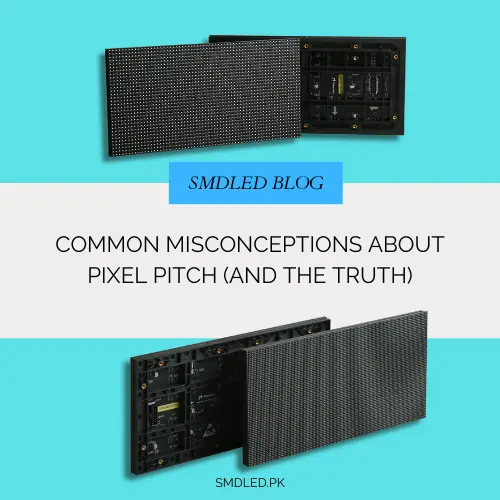
Common Misconceptions About Pixel Pitch (And the Truth)
When businesses in Pakistan decide to invest in digital signage, they are immediately confronted with a barrage of technical jargon. Of all the specifications thrown around during the purchasing process, pixel pitch is undoubtedly the most critical—and the most commonly misunderstood.
It is easy to assume that buying a screen is just like buying a television for your living room: you simply look for the highest resolution you can afford and make the purchase. However, the architecture of commercial SMD screens in Pakistan operates on entirely different principles. Making assumptions about pixel pitch without understanding the underlying physics of digital displays can lead to massive budget overruns or a viewing experience that looks terribly pixelated to your audience.
In this comprehensive guide, we are going to tear down the technical barriers. We will define exactly what pixel pitch is, expose the most dangerous myths surrounding it, and give you the actionable truth so you can make an informed, cost-effective decision for your next project.
What Exactly is Pixel Pitch?
Before we debunk the myths, we must define the term. Pixel pitch, often referred to as dot pitch, is the precise physical distance from the center of one LED pixel (or cluster of diodes) to the center of the adjacent LED pixel. This measurement is universally expressed in millimeters (mm) and is usually denoted by the letter “P” followed by a number.
For example, if you are looking at a P3 display, it means the pixel pitch is exactly 3 millimeters. A P10 display has a pixel pitch of 10 millimeters.
Because this metric defines the amount of empty space between the light-emitting diodes, it directly correlates to the pixel density of the screen. A smaller pixel pitch means that the pixels are packed tightly together, leaving less empty, dark space on the module. This results in a much higher pixel density, which translates to a sharper, more detailed image when viewed from up close. Conversely, a larger pixel pitch means the pixels are spread further apart, which lowers the pixel density and reduces the manufacturing cost, making it ideal for massive displays viewed from a distance.
With the basic definition out of the way, let us address the most pervasive misconceptions that confuse buyers when browsing SMD LED products.
Misconception 1: A Smaller Pixel Pitch is Always Better
This is, without a doubt, the most expensive misconception in the digital signage industry. Because we are conditioned by smartphones and desktop monitors to constantly chase higher resolutions, buyers naturally assume that a smaller pixel pitch automatically equates to a “better” screen.
The Truth: A smaller pixel pitch is only “better” if your audience is standing extremely close to the screen.
When you decrease the distance between pixels, you exponentially increase the number of LED diodes required to build the screen. More diodes mean more wiring, more complex circuit boards, higher power consumption, and a dramatically higher manufacturing cost. If you purchase an ultra-fine display with a 1.2mm pixel pitch and install it on a billboard 50 feet in the air, you have completely wasted your money.
Human visual acuity has its limits. From 50 feet away, the human eye physically cannot distinguish the difference between a 1.2mm pixel pitch and an 8mm pixel pitch. The visual data simply blends together into a smooth image before the light reaches the retina.
Therefore, you should never buy the smallest pixel pitch you can afford; you should buy the correct one for your specific environment. If you are building a control room or a luxury retail display where viewers are an arm’s length away, a product like the BIA Indoor SMD Screen Module with a fine pitch is perfect. If it is a rooftop billboard, a coarser pitch is the smarter, more economical choice.
Misconception 2: Pixel Pitch is the Exact Same Thing as Resolution
It is very common for buyers to use these two terms interchangeably. A client might say, “I need a screen with a 4K pixel pitch,” which is a fundamentally flawed sentence.
The Truth:
Pixel pitch and resolution are deeply interconnected, but they are entirely different measurements.
Pixel pitch is a fixed physical measurement of distance (in millimeters). Resolution, on the other hand, is the total mathematical count of pixels on a specific display (usually written as Width × Height, like 1920 × 1080).
Here is where it gets interesting: you can achieve a 4K resolution using any pixel pitch, but the physical size of the screen will change drastically based on your choice.
If you want to build a true 4K video wall using a fine 1.5mm pixel pitch, your screen will be relatively compact—perfect for a corporate boardroom. However, if you want that exact same 4K resolution but decide to use a 10mm pixel pitch, your screen would need to be massive—roughly the size of a multi-story building—to fit all those pixels.
This is why understanding your spatial constraints is vital. If you only have a limited amount of wall space but absolutely require high-definition content, you must opt for a smaller pixel pitch. If you want a brilliant, pre-configured high-resolution setup without the guesswork, exploring solutions like the BIA HDR 4K LED Video Wall can provide the perfect balance of pitch and resolution.
Misconception 3: Viewing Distance Doesn’t Matter if the Screen is High Quality
Many buyers assume that if they purchase a premium display from a top-tier manufacturer, the quality of the internal components will somehow override the laws of physics, allowing the screen to look perfect from any distance.
The Truth:
Viewing distance is the single most important factor when selecting your pixel pitch.
If a viewer stands closer to the screen than the optimal viewing distance, the image will “break apart.” The viewer will begin to see the individual black gaps between the LEDs, leading to a pixelated, blocky, and distracting image.
In the digital signage industry, engineers rely on mathematical formulas to calculate visual acuity. The formal calculation for the absolute minimum visual acuity distance (the point at which a person with 20/20 vision can no longer resolve individual pixels) relies on the optical formula:
$$D_{optimal} = \rho \times 3.438$$
Where $D_{optimal}$ is the viewing distance in millimeters and $\rho$ represents the pixel pitch in millimeters.
However, for everyday practical applications, the industry uses a much simpler rule of thumb: 1 millimeter of pixel pitch equals roughly 1 meter of minimum viewing distance.
- P1.5 (1.5mm): Viewers can stand as close as 1.5 meters (approx. 5 feet).
- P4 (4mm): Viewers should be at least 4 meters away (approx. 13 feet).
- P10 (10mm): Viewers should be at least 10 meters away (approx. 33 feet).
Before you even ask for a price quote, take a tape measure to your installation site. Measure the exact distance from where the screen will be mounted to where the closest person will be standing. That single measurement will instantly dictate the perfect pixel pitch for your project.
Misconception 4: Indoor and Outdoor Screens Can Use the Same Pixel Pitch
Sometimes, a business owner will purchase a successful indoor display, love the crisp quality, and insist on using that exact same pixel pitch for an outdoor project, assuming the visual results will be identical.
The Truth:
Indoor and outdoor environments have vastly different requirements, and applying indoor logic to outdoor screens is a recipe for failure.
Outdoor screens are typically viewed from much greater distances—by people driving in cars or walking across large plazas. Because of this expanded viewing distance, a fine pixel pitch is completely wasted outdoors. More importantly, outdoor screens face the relentless glare of the sun. To combat direct sunlight, outdoor LEDs must be incredibly bright (often exceeding 6,000 nits).
It is physically challenging and prohibitively expensive to pack ultra-bright, weather-sealed, heavily protected diodes into a microscopic pixel pitch. If you pack them too tightly outdoors, heat dissipation becomes a massive engineering hurdle.
This is why the BIA Outdoor SMD Screen Module is engineered differently than its indoor counterparts. Outdoor modules rely on a larger pixel pitch (usually ranging from P5 to P16) to allow for larger, brighter diodes, robust weatherproofing, and adequate airflow to survive the harsh Pakistani summers. Indoor modules prioritize a smaller pixel pitch because climate control is managed, and viewers are standing merely feet away.
Misconception 5: High Pixel Pitch Means “Poor” Image Quality
Because we associate smaller numbers with higher tech (like nanometer sizes in computer chips), buyers look at a P10 or P16 screen and assume the image quality is inherently “bad” or outdated.
The Truth:
A large pixel pitch does not mean poor image quality; it simply means the image is designed for a large canvas and a long throw distance.
Think of a traditional billboard painter. If you walk right up to a hand-painted billboard and press your nose against the wood, it looks like a chaotic, messy series of giant brushstrokes. It looks “poor.” But if you step back 100 feet, those brushstrokes form a beautiful, photorealistic image.
A large pixel pitch works exactly the same way. When an outdoor P10 screen is viewed from its intended distance of 30 to 50 feet away, the image quality is spectacular. The colors are vibrant, the contrast is deep, and the video playback is incredibly smooth. By utilizing a larger pixel pitch for distant viewing, you ensure phenomenal image quality while saving thousands of dollars that would have been wasted on unnoticeable pixel density.
How to Calculate the Perfect Pixel Pitch for Your Needs
Now that we have separated the facts from the fiction, how do you actually make the right choice? The process of selecting the ideal pixel pitch involves a systematic evaluation of your specific use case. Follow this step-by-step framework:
1. Identify the Primary Audience Location
Do not guess. Physically stand where your screen will be installed and walk to where the closest audience member will be. If it is a shopping mall directory, they will be touching it (requiring a sub-2mm pixel pitch). If it is a high-way billboard, they will be in cars 100 feet below (requiring an 8mm to 16mm pixel pitch).
2. Evaluate the Content Type
What are you actually going to show on the screen?
- Text-Heavy Content: If you are displaying complex spreadsheets, intricate charts, or dense paragraphs of text, you need a smaller pixel pitch to ensure the edges of the fonts render smoothly.
- Video and Bold Graphics: If you are showing sweeping landscape videos, large logos, or bold promotional imagery, you can easily get away with a larger pixel pitch. The movement in video naturally smooths over pixel gaps in the human brain.
3. Consider Your Screen Size
As we established earlier, your target resolution and your pixel pitch will dictate your physical screen size. If you are restricted to a 3-meter wide wall but you want to show full 1080p HD video natively, you are mathematically forced to choose a fine pixel pitch to fit all 1,920 horizontal pixels into that 3-meter space.
4. Factor in the Budget
The relationship between pixel pitch and cost is not linear; it is exponential. Moving from a P4 to a P2 screen does not just double your cost; it can quadruple it, because you are dealing with exponentially more diodes, soldering points, and processing power. Always buy the largest pixel pitch that your minimum viewing distance will comfortably allow.
The Ultimate Balance
Choosing the right pixel pitch is not a battle of “better versus worse.” It is a delicate balancing act of optical science, environmental analysis, and financial practicality.
When you strip away the misconceptions, the golden rule remains clear: Match your pixel pitch to your viewing distance. Do not overpay for pixel density your audience will never see, and do not compromise on pitch if your audience will be interacting with the screen up close.
By understanding how pixel pitch influences resolution, viewing distance, and cost, you take control of your digital signage investment. You ensure that your brand is represented with clarity, professionalism, and stunning visual impact.
Frequently Asked Questions (FAQs)
1. What is pixel pitch in simple terms?
Pixel pitch is the exact distance, measured in millimeters, from the center of one LED cluster to the center of the next adjacent LED cluster on a digital screen. It defines how tightly the light pixels are packed together.
2. Is a smaller pixel pitch always the better choice?
No. While a smaller pixel pitch provides higher resolution for close-up viewing, it is unnecessary and not cost-effective for screens viewed from a long distance. Always align the pitch with the viewing distance of your audience.
3. How do I calculate the best pixel pitch for my screen?
A general rule of thumb is that 1 millimeter of pixel pitch corresponds to about 1 meter of optimal viewing distance. Therefore, a P4 (4mm) screen is optimal for viewers standing roughly 4 meters away.
4. Does pixel pitch affect the brightness of the screen?
Not directly. Brightness is determined by the quality and power of the LED diodes, not just the distance between them. However, outdoor screens usually use a larger pixel pitch to accommodate larger, higher-intensity diodes that can compete with direct sunlight.
5. What is the difference between indoor and outdoor pixel pitch?
Indoor screens typically require a smaller pixel pitch (e.g., 1.5mm to 4mm) because audiences are closer, and the environment is climate-controlled. Outdoor screens use a larger pixel pitch (e.g., 6mm to 10mm+) because viewers are farther away, and the modules need space for robust weatherproofing and heat dissipation.
Ready to Transform Your Visual Communication?
Understanding the technical nuances of pixel pitch is just the first step. Translating that knowledge into a flawless, high-performing digital display requires partnering with industry experts. At SMD LED, we specialize in helping Pakistani businesses navigate these complex choices to find the absolute perfect balance of quality and cost.
Whether you need an ultra-fine indoor display for a corporate boardroom or a massive, weather-beating outdoor billboard, our technical team is here to guide you. Stop guessing with your digital signage budget. Contact us today to discuss your project requirements, or Follow us on Facebook to see our latest groundbreaking installations across Pakistan! Would you like me to generate the next article for your list, or would you prefer to explore specific product recommendations for your site?