 Outdoor SMD Screens
 Indoor SMD Screens
 Flexible SMD Screens

How Pakistan’s News Channels (GEO, ARY) Use Video Wall Technology
Note: this article describes how news channels such as GEO News and ARY News typically use video walls, as illustrative…
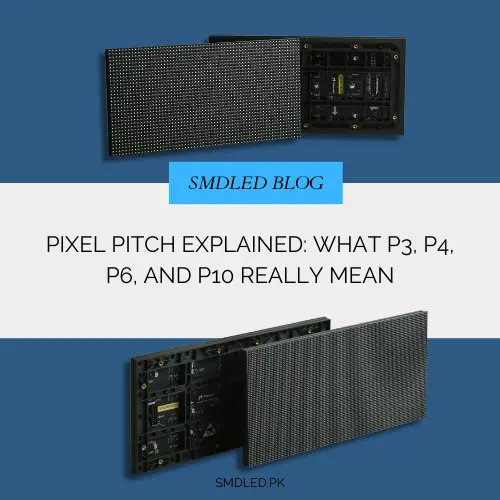
When buying or renting an SMD screen, one term appears everywhere and is often misunderstood: pixel pitch. This guide gives you pixel pitch explained in simple, practical language, whether you are planning an indoor display, an outdoor billboard or a rental video wall.
Many buyers in Pakistan end up with an unsuitable screen because pitch, resolution and environment were not explained separately. This guide aims to help you avoid that.
Pixel pitch is the distance, in millimetres, between the centre of one pixel and the centre of the next on an LED screen. It is written as P followed by a number.
Examples
• P3 means about 3 mm
• P4 means about 4 mm
• P6 means about 6 mm
• P10 means about 10 mm
A smaller number means pixels are closer together. Many products use slightly different exact values (for example P2.9 or P3.91), so check the datasheet.
Pixel pitch strongly influences
• Image detail
• Suitable viewing distance
• Cost per square metre
It does not by itself decide brightness, weather protection or durability. Those depend on whether the product is an indoor or outdoor model and on its build quality. Choosing the wrong pitch leads to poor visuals or unnecessary expense.
Smaller pixel pitch
• More pixels in the same area
• More detail at close range
• Usually higher cost per area
Larger pixel pitch
• Fewer pixels in the same area
• Fine for longer viewing distances
• Usually lower cost per area
Pitch and resolution are not the same thing. A screen’s native resolution depends on its size and pitch:
Pixels across = width (mm) ÷ pitch (mm)
Pixels down = height (mm) ÷ pitch (mm)
Example: a screen 4 m wide and 2.25 m high
• At P3: about 1,333 × 750 pixels
• At P6: about 667 × 375 pixels
• At P10: 400 × 225 pixels
The same size screen shows far more detail at a finer pitch. Use this calculation to check that your content, especially text, will be readable.
The uses below are typical, not fixed rules. Every pitch is made by many manufacturers, often in both indoor and outdoor versions.
P3 means pixels are about 3 mm apart.
Often used for
• Indoor video walls
• Meeting rooms and studios
• Lecture halls
• Outdoor screens viewed at close range (in outdoor-rated versions)
Strengths
• Good detail at short viewing distances
Considerations
• Higher cost per area than coarser pitches
• For outdoor use, choose an outdoor-rated P3 with suitable brightness
Indoor options include the BIA Indoor SMD Screen Module.
P4 is a balanced middle option.
Often used for
• Indoor halls and shop fronts
• Corporate events
• Rental screens
Strengths
• Good clarity at moderate distances
• Moderate cost
Considerations
• Less detail than P3 for very close viewing
P6 is common where viewers are further away.
Often used for
• Outdoor advertising
• Roadside displays
• Large event screens
Strengths
• Lower cost per area than finer pitches
• Works well at distance
Considerations
• Less sharp up close
• Brightness depends on the product, not the pitch
Outdoor options include the BIA Outdoor SMD Screen Module.
P10 is a common economical choice for very long viewing distances. Coarser pitches such as P16 also exist.
Often used for
• Highways
• Large billboards
• Some stadium screens
Strengths
• Usually lower cost per area
• Suited to distant viewing
Considerations
• Not suitable for close viewing
• Low resolution for its size
• Durability depends on the outdoor rating and build quality, not on pitch
A common rule of thumb:
Minimum comfortable viewing distance in metres ≈ pixel pitch in mm
Examples
• P3 → about 3 m
• P6 → about 6 m
• P10 → about 10 m
This is only a starting point. Content, eyesight, the screen’s resolution and the quality of calibration all affect how a screen looks. For important projects, view a sample at the real distance.
A smaller pitch means
• More pixels per square metre
• Higher resolution for a given size
• More detail
Premium indoor video walls therefore often use fine pitches, P2.5 and finer, down to around 1 mm or less in some products. For example, our BIA HDR 4K LED Video Wall range is a fine-pitch option. Whether a wall reaches 4K depends on its size and configuration, so ask us for the configuration for your space.
Pitch and environment are separate choices.
Indoor screens
• Often fine to medium pitches
• Indoor brightness
• Close viewing
Outdoor screens
• Often medium to coarse pitches, but finer outdoor pitches exist for close viewing
• High brightness and weather protection
• Often longer viewing distances
Choose the environmental rating for the site, then the pitch for the viewing distance.
Common mistakes include
• Using a coarse pitch where viewers stand close
• Paying for a fine pitch when everyone is far away
• Ignoring the native resolution and content
• Assuming pitch decides brightness or weatherproofing
Smaller pixel pitch
• More LEDs and driver ICs per area
• Usually higher cost per area
Larger pixel pitch
• Fewer LEDs per area
• Usually lower cost per area
• Lower resolution for a given size
Understanding this trade-off helps you spend wisely.
Ask these questions
• How close will the nearest typical viewers be?
• Indoor, semi-outdoor or outdoor?
• What content will you show?
• What is the budget?
Professional guidance helps avoid costly mistakes. Explore our SMD screens or contact us for advice.
It is the distance between the centres of neighbouring pixels, in millimetres.
No. A finer pitch shows more detail but costs more; whether you need it depends on viewing distance and content.
It depends on viewing distance. Coarser pitches such as P6, P8 or P10 are common for distant viewing; finer outdoor pitches suit closer viewing. Always choose an outdoor-rated product.
For close indoor viewing, around P2.5 to P3 is common, and finer pitches are used for very close viewing such as boardrooms and studios.
Yes. Finer pitches usually cost more per area because they need more LEDs and driver ICs.
With pitch, resolution and environment considered separately, choosing the right SMD screen becomes much easier.
Explore SMD screen options, browse products, get expert guidance, or follow us on Facebook.

Note: this article describes how news channels such as GEO News and ARY News typically use video walls, as illustrative…

Note: this article uses LUMS and NUST as illustrative examples of leading Pakistani universities. It does not describe their actual…

The Legal Guide to Digital Billboards in Pakistan Important: this page is general background information, not legal advice. Rules for…