
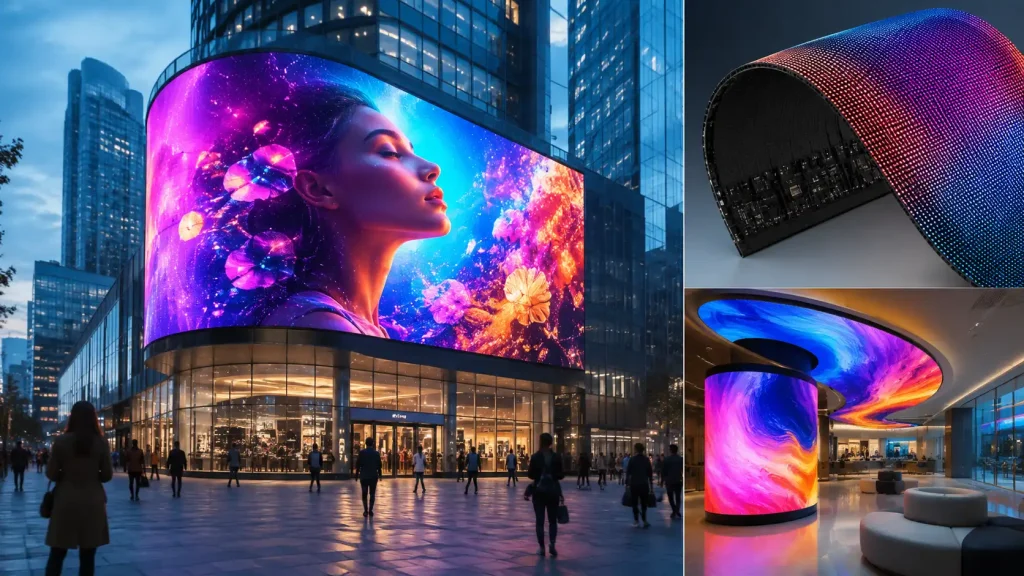
Flat LED panels solve rectangular problems. Creative advertising rarely presents a rectangular problem. Retail columns, curved shopfronts, reception wave ceilings, spiral staircases and cylindrical brand totems all need a display surface that follows the architecture instead of fighting it. Flexible LED modules use a rubber or silicone backed substrate that bends to a cylinder as tight as 0.61 m in diameter, weighs 30 to 45 kg per square metre and sits 6.6 mm thick. This guide covers where flexible displays outperform rigid cabinets, where they fail, and what the full installed cost actually looks like in Pakistan.
What Makes a Flexible LED Module Different
Construction and Bending Behaviour
A rigid module mounts its LED lamps on a fibreglass board inside an aluminium cabinet. A flexible module mounts the same lamps on a thin flexible circuit carried by a soft polymer mask, then fixes to the surface with magnets or adhesive rather than a frame. The mask absorbs deformation, so the module can curve convex or concave without cracking solder joints. Bending is limited by radius, not by angle: exceed the minimum radius and the lamp pitch on the outer face stretches, which shows as visible pixel spacing along the curve.
Typical Flexible Module Specification
| Attribute | Typical value | What it controls |
| Pixel pitch | 1.25 mm to 4 mm | Close range legibility on the curve |
| Module size | 320 x 160 mm | How smoothly the surface follows a radius |
| Thickness | 6.6 mm | Whether the display sits flush inside a recess |
| Weight | 30 to 45 kg per square metre | Substructure load rating |
| Brightness | 500 nits and above | Indoor use only, not sunlit facades |
| Minimum cylinder diameter | 0.61 m | Tightest column the surface can wrap |
| Refresh rate | 2000 Hz and above | Camera and phone capture quality |
| Ingress protection | IP43 | Splash resistance only, not weatherproof |
| Operating temperature | Minus 20 C to plus 50 C | Enclosed atrium and shopfront tolerance |
| Maximum power draw | 350 W per square metre | Circuit sizing and running cost |
Creative Applications Rigid Panels Cannot Deliver
Cylindrical Columns and Brand Totems
Mall atriums in Lahore and Karachi carry structural columns between 0.7 m and 1.2 m in diameter. Wrapping one in a continuous 360 degree display converts dead structure into an advertising asset visible from every approach angle. A 0.9 m diameter column standing 3 m high yields roughly 8.5 square metres of display surface with no viewing dead zone.
Curved Shopfronts and Wave Ceilings
Flexible modules follow concave and convex sweeps across retail entrances, hotel lobbies and showroom soffits. Because the module attaches magnetically, the installer aligns to the architectural curve rather than forcing the architecture to accept a flat cabinet grid. The same approach is described in our field notes on flexible LED screens in creative installations.
Irregular Surfaces, Furniture and Vehicles
Reception desks, exhibition pods, stage props and branded vehicles all present surfaces that no cabinet fits. A 6.6 mm module adds negligible depth, which keeps the original form intact. Customer reaction to these installations is covered in how flexible SMD displays create unique visual experiences.
Where Flexible Displays Fail
Suppliers rarely publish the limits. Specify around these four before committing the budget.
- Brightness ceiling. At 500 to 800 nits, a flexible module washes out under a glazed atrium roof at midday. Sunlit positions need outdoor rated rigid modules at 4000 nits and above.
- Ingress rating. IP43 covers dripping water at an angle, not driven by monsoon rain. Flexible modules belong indoors or under a fully covered canopy.
- Heat dissipation. A curved surface traps warm air against itself. Keep a 100 mm ventilated cavity behind the substructure and avoid enclosing the assembly in sealed acrylic.
- Bend fatigue. Flexible modules are designed to be shaped once and left in place. Repeated reshaping for touring or seasonal reuse shortens service life and stresses the lamp joints.
Specification to Application Matching
| Project type | Recommended pitch | Surface geometry | Critical requirement |
| Mall column wrap, shoppers within 2 m | 1.86 mm to 2.5 mm | Full cylinder, 0.7 m diameter and above | Seam alignment at the closing joint |
| Retail shopfront curve | 2.5 mm | Gentle convex sweep | Ambient light survey before brightness sign off |
| Hotel lobby wave ceiling | 3 mm to 4 mm | Compound curve viewed from 4 m plus | Substructure load path and service access |
| Reception desk fascia | 1.25 mm to 1.86 mm | Shallow concave | Close viewing distance, high pixel density |
| Exhibition pod or product plinth | 2.5 mm | Multiple short radii | Fast install and demount without frame damage |
| Spiral staircase ribbon | 3 mm | Helical, continuously varying radius | Geometry correction in the content pipeline |
The Cost Nobody Quotes: Substructure Fabrication
Buyers compare LED prices and miss the frame. A flexible display needs a fabricated backing that holds the exact intended curve, carries 30 to 45 kg per square metre, and provides service access to every module. On tight radii and compound curves, that steel or aluminium substructure frequently costs as much as the LED modules themselves. Budget the project in four lines rather than one:
- LED modules and power supplies
- Fabricated substructure, finish and fixings
- Control system, processor and cabling
- Content geometry mapping and the first content set
- SMDLED engineering supports these creative applications with custom substructure design.
Ask for the substructure drawing before you approve the quotation. If a supplier quotes only a per square metre LED rate for a curved job, the number is incomplete.
Running Cost and Comparison With Printed Alternatives
Calculate electricity from area, not from panel count. An 8.5 square metre column at an average draw near 130 W per square metre pulls about 1.1 kW. Running 14 hours a day for 30 days consumes roughly 464 units. At commercial tariffs close to Rs 44 per unit, that is near Rs 20,400 a month.
| Cost line | Printed vinyl column wrap | Backlit acrylic curve | Flexible LED display |
| Creative change | Reprint and reinstall each time | Reprint the graphic layer | File upload, no physical work |
| Campaigns per year | Limited by print budget | Limited by print budget | Unlimited, including dayparted content |
| Motion and video | None | None | Full motion at 60 fps |
| Electricity | None | Low | Moderate, roughly 130 W per square metre average |
| Service life | 6 to 12 months before fade | 2 to 3 years | 100,000 hours of lamp life |
| Repair unit | Full rewrap | Full graphic panel | Single module swap |
The decision hinges on campaign frequency. A brand that changes creative twice a year gains little. A mall selling advertising slots to multiple tenants, or a retailer running weekly promotions, recovers the premium through content velocity alone. Mall operators can see the wider revenue case in LED video walls for shopping mall advertising.
Pakistan Site Conditions to Verify First
| Condition | Local reality | Design response |
| Atrium daylight | Glazed mall roofs in Lahore push interior lux very high at midday | Take a lux reading at the exact position before approving 500 nit modules |
| Smog season dust | October to January raises airborne particulate sharply | Quarterly soft brush cleaning; avoid wet wipe on IP43 surfaces |
| Supply voltage | 230 V nominal with regular sag and surge | Servo stabiliser ahead of the power supply rack |
| Monsoon humidity | July to mid September | Seal the cavity behind the curve and store spares with desiccant |
| Summer heat | Interiors exceed 35 C when cooling lags footfall | Ventilated cavity of 100 mm and no sealed enclosure |
| Spare part supply | Curved projects use non standard module counts | Order 5 percent spares with the original batch for colour match |
Selection Checklist Before You Sign
- Minimum bending radius stated in millimetres, not described as flexible.
- Brightness measured in nits at the installed position, with a site lux reading on record.
- Substructure drawing, load calculation and finish specification included in the quotation.
- Geometry mapping and pixel map supplied to your content designer before artwork.
- Spare modules from the same production batch, quoted with the main order.
- Written warranty term and a named local service contact.
Rigid alternatives remain the right answer for flat walls and sunlit positions. Compare both paths through our indoor SMD screen solutions, the slim profile ultra thin SMD screen module and the ultra thin SMD LED screen module range.
Start With the Surface, Not the Screen
Send the architectural drawing or a photograph with dimensions before selecting any module. Radius, viewing distance and ambient light decide the specification; the display is the last decision, not the first. Browse options in the full SMD and LED display catalogue, then book a site survey with our SMDLED Lahore team for a measured curve assessment, substructure proposal and installed cost breakdown.