
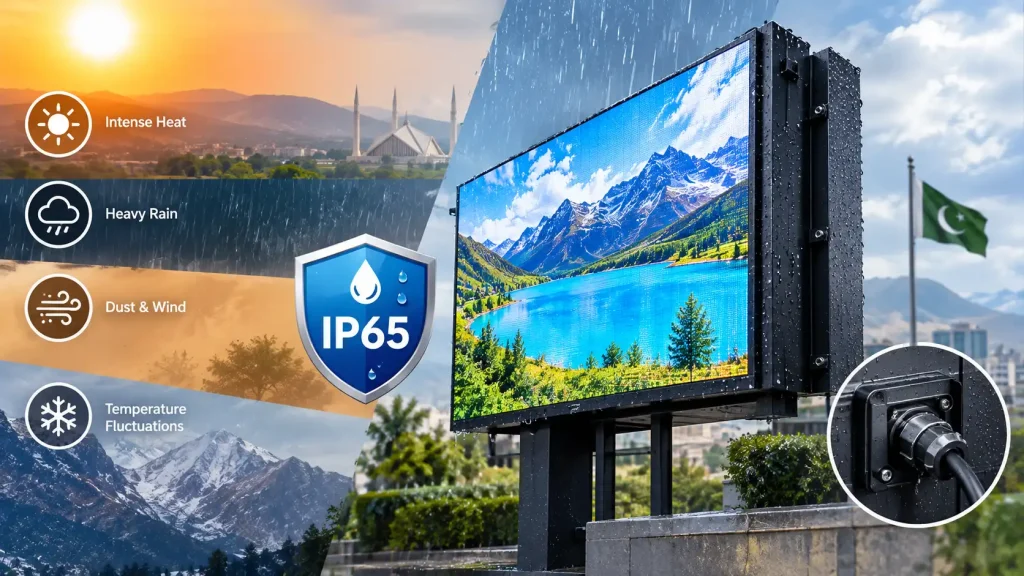
“IP65” appears on almost every outdoor LED screen quote in Pakistan. It sounds like a guarantee. It is not.
IP65 tells you the screen passed a dust test and a water-jet test in a lab. It says nothing about 50°C cabinet heat in Jacobabad, salt corrosion on a Clifton seafront, or a cable gland left loose after a technician’s visit. Those are the things that actually kill outdoor screens here.
This guide explains what IP65 covers, where it stops, and what each Pakistani climate zone demands on top of it.
What IP65 Actually Means
IP65 comes from the IEC 60529 standard.
- 6 (dust): The enclosure is dust tight. In testing, it sits in a talc-dust chamber for up to 8 hours with no dust getting inside.
- 5 (water): It resists water jets from a 6.3 mm nozzle, at 12.5 litres per minute, from any direction, for at least 3 minutes.
That is strong protection against dust storms and driving monsoon rain. It is not protection against standing water or submersion. For flood zones and floor-mounted screens, you need IP67 or IP68. We compare these in detail in our IP65 vs IP68 waterproofing guide.
What IP65 Does Not Cover
Here is where most buyers get caught. An IP rating is silent on:
| Threat | Covered by IP65? | What Protects Against It |
| Dust storms | Yes | Dust-tight seals, filtered fans |
| Driving rain | Yes | Sealed modules and gaskets |
| Heat above 45°C | No | Ventilation design, heat-rated power supplies |
| UV degradation of masks and gaskets | No | UV-stabilised plastics and silicone |
| Salt air corrosion | No | Conformal coating, aluminium cabinets, coated connectors |
| Condensation inside cabinets | No | Breather valves, moisture-absorbing design |
| Lightning and voltage surges | No | Earthing, SPDs, lightning arresters |
| Wind load | No | Structural engineering |
| Poor workmanship after servicing | No | Correct re-sealing procedures |
So IP65 is the minimum entry ticket. Real weatherproofing is a system.
Pakistan Climate Zone Matrix
Pakistan does not have one climate. A screen that thrives in Islamabad may fail early in Karachi or Sukkur. This matrix is built from what we see on real installations.
| Region | Main Threats | Minimum Spec | Extra Protection We Recommend |
| Karachi, Gwadar, coastal Sindh and Balochistan | Salt air, 70 to 85% humidity, corrosion | IP65 front and rear | Aluminium cabinets, conformal-coated PCBs, stainless fixings, sealed connectors |
| Lahore, Faisalabad, Gujranwala | Heat to 47°C, monsoon downpours, winter smog | IP65 front | Rated fans, drainage holes at cabinet base, high brightness headroom |
| Multan, Bahawalpur, south Punjab | Extreme heat, dust storms | IP65 front, IP54+ rear | Filtered ventilation, heat-rated PSUs, quarterly dust cleaning |
| Jacobabad, Sukkur, interior Sindh | Heat above 50°C, low humidity | IP65 | Light-coloured cabinet backs, shading hood, thermal cut-off |
| Islamabad, Rawalpindi, Murree foothills | Heavy rain, hail, lightning | IP65 front and rear | Lightning protection, hail-resistant masks, strong earthing |
| Peshawar, Quetta | Dust, strong UV, cold winters | IP65 | UV-stable masks, cold-start power supplies |
| Gilgit-Baltistan, upper KP | Sub-zero temperatures, snow | IP65 | Low-temperature rated components, anti-condensation heating |
Lahore buyers should also read our focused guide on weatherproofing your SMD screen for Lahore’s monsoon and heat. Local support is available through our SMD screen provider pages for Karachi, Islamabad and Multan.
The Five Layers of Real Weatherproofing
Layer 1: Module-Level Sealing
The LED module is the first line of defence. Outdoor modules use silicone potting (a waterproof glue layer) around the LEDs and a sealed back shell. Poor-quality potting cracks under UV within two summers. Our SMD screen modules guide explains what to check on the back of a module.
Older DIP screens were naturally more rugged but far less sharp. Modern outdoor SMD modules now match that ruggedness when built properly, which we cover in DIP vs SMD technology in Pakistan.
Layer 2: Cabinet Construction
- Iron cabinets: Cheaper, but rust at welds and screw points, especially near the coast.
- Die-cast aluminium cabinets: Lighter, rust-free, better heat transfer. Worth the extra cost in Karachi and humid zones.
- Gaskets: Rubber or silicone gaskets must be UV-rated. Cheap gaskets harden and crack in two to three years.
Layer 3: Cable Entry and Drainage
Most water damage we repair enters through cables, not through the screen face.
- Use IP-rated cable glands at every entry point
- Route cables to enter from below, with a drip loop
- Keep drainage holes at the cabinet base clear, so water that does enter can escape
Layer 4: Heat Management
Heat kills more screens in Pakistan than water does. A common electronics rule of thumb says the capacitors inside power supplies lose about half their life for every 10°C rise in operating temperature. Specify:
- Power supplies rated for 50°C+ ambient
- Fans with dust filters, cleaned every quarter
- Clear airflow gaps behind the cabinets, at least 600 to 800 mm for rear-service access and air
- Automatic brightness control, so the screen is not running at full load at midnight
Layer 5: Electrical Protection
- Proper earthing with measured resistance
- Surge protection devices on the main supply
- Lightning arresters on tall poles and rooftops, especially in Islamabad and the north
- Voltage stabiliser to handle Pakistan’s grid swings
Weatherproofing Mistakes We See Every Monsoon
- Re-sealing skipped after repair. A technician swaps a module in August and leaves one gasket unseated. Water gets in within a week.
- Cables entering from the top. Water runs down the cable straight into the cabinet.
- Blocked rear vents. Birds’ nests and dust bags trap heat.
- No drainage path. Condensation collects at the bottom of the cabinet and corrodes the receiving card.
- Structure without slope. Rooftop frames that collect water around the screen base.
Many of these begin at installation. Our list of common SMD screen installation mistakes is worth reading before your installer arrives.
Seasonal Weatherproofing Calendar for Pakistan
| Months | Weather Event | What to Check |
| February to March | Pre-summer | Clean fan filters, test thermal sensors, check PSU fans |
| April to June | Heat waves and dust storms | Monthly dust cleaning, check cabinet temperature logs, confirm auto-dimming |
| Late June | Pre-monsoon | Inspect gaskets, cable glands, drainage holes, re-torque cabinet locks |
| July to September | Monsoon | Visual check after every heavy storm, look for water marks and dead modules |
| October to November | Post-monsoon | Open cabinets, check for moisture and corrosion, dry and re-seal |
| December to January | Fog, smog, cold | Check brightness settings for low visibility, cold-start behaviour in the north |
Our general guide to maintaining your SMD screen turns this into a monthly checklist.
When IP65 Is Not Enough
Choose IP67 or IP68 when:
- The screen sits at ground level where rainwater pools
- It is a walk-on or floor screen, like the ones in our floor SMD screens for events and stages guide
- It is mounted on a moving vehicle that faces road spray and vibration, as covered in mobile SMD screens and video vans
- It is installed near fountains or water features
Cost of Weatherproofing vs Cost of Failure
| Option | Upfront Extra Cost | Typical Result After 3 Years in Karachi |
| Basic IP65 front, iron cabinet | Baseline | Rust at joints, corroded connectors, rising module failures |
| IP65 front and rear, aluminium cabinet | About 8 to 15% more | Stable colour, few failures |
| Full spec with conformal coating and SPD | About 12 to 20% more | Lowest repair spend, longest life |
One water-damaged receiving card or a row of dead modules in peak campaign season often costs more in lost airtime than the upgrade would have.
How SMDLED Builds for Pakistani Weather
Our BIA Outdoor SMD screen module is designed for outdoor heat and rain, with pixel-level calibration and adjustable brightness for day and night. We match cabinet type, sealing and electrical protection to your city, not to a generic catalogue. See the full range of outdoor SMD screens built for Pakistani conditions.
Planning an outdoor screen in a tough location? Share your site photos and city through our contact page and our engineers will recommend the right protection level.
Frequently Asked Questions
Is IP65 waterproof?
IP65 is water-resistant against jets and heavy rain. It is not rated for submersion. Use IP67 or IP68 where water can pool.
Does IP65 protect against heat?
No. Heat protection comes from ventilation, heat-rated components and brightness control, not from the IP rating.
Which cabinet material is best for Karachi?
Die-cast aluminium, with coated connectors and stainless fixings. Iron cabinets rust quickly in coastal air.
How often should an outdoor screen be inspected?
Monthly visual checks, plus full inspections before and after the monsoon.