
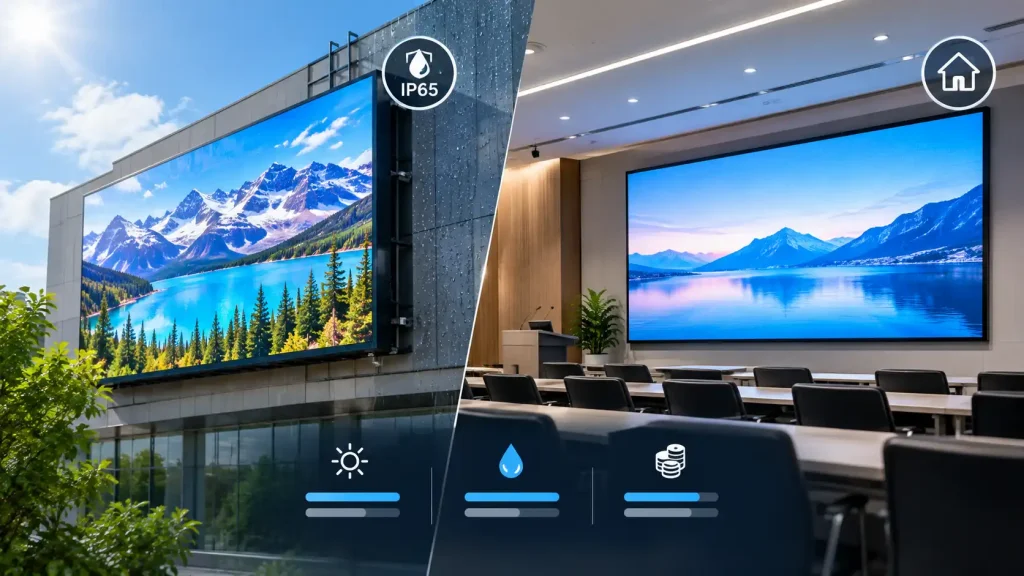
An indoor LED screen and an outdoor LED screen can look identical in a showroom. Put them both on a Lahore shop front at 2 pm in June, and one becomes a dark grey rectangle within minutes. The other stays readable from across the road.
The difference comes down to three numbers: brightness in nits, the IP rating, and cost per square foot. Get those three right and the rest of the specification falls into place.
The Quick Answer
- Indoor LED screens run at 600 to 1,500 nits, carry low ingress protection (around IP30 to IP43), use fine pixel pitches from P1.2 to P4, and cost less per square foot at the same pitch.
- Outdoor LED screens run at 5,000 to 8,000 nits or more, carry IP65 on the front, use pitches from P3 to P10 and above, and cost 30 to 50 percent more at the same pitch.
- Semi-outdoor screens sit in between at around 2,500 to 4,500 nits for covered spaces and sun-facing shop windows.
Brightness: Why Nits Decide Everything
A nit is one candela per square metre. It measures how much light the screen pushes toward the viewer.
Direct sunlight on a Pakistani afternoon can exceed 100,000 lux on the screen face. A screen needs enough brightness to beat that reflected glare. Indoors, the opposite problem applies: a 6,000-nit screen in a boardroom is painful to look at, and dimming it too far crushes the grey levels and makes images look blotchy.
| Environment | Recommended Brightness | Example in Pakistan |
| Boardroom, control room, TV studio | 500 to 800 nits | Corporate offices in Islamabad Blue Area |
| Mall interior, banquet hall, retail | 800 to 1,500 nits | Wedding halls, mall atriums |
| Shop window facing the street | 2,500 to 4,500 nits | Liberty Market, Tariq Road storefronts |
| Covered canopy or veranda | 3,000 to 4,500 nits | Petrol pump canopies, drive-throughs |
| Open roadside, shaded part of the day | 5,000 to 6,000 nits | North-facing building fronts |
| Direct sun, south or west facing | 6,500 to 8,000+ nits | Rooftop billboards, highway poles |
For the Punjab sun specifically, our article on outdoor SMD screen brightness in Lahore explains how orientation changes the nit rating you actually need.
The Brightness Trap: Grayscale Loss at Night
Outdoor screens must dim at night. Cheap controllers dim by throwing away bit depth, so a screen that looked rich at noon looks banded at 10 pm. Ask for a controller that keeps 14-bit or higher processing when dimmed. Our explainer on the science of grayscale in SMD LED screens shows why this matters for skin tones and brand colours.
IP Rating: What the Two Digits Mean
IP stands for Ingress Protection. The first digit rates protection against solids (dust), the second against liquids (water).
| Rating | Dust Protection | Water Protection | Typical Use |
| IP30 | Objects over 2.5 mm | None | Indoor, controlled rooms |
| IP43 | Objects over 1 mm | Spraying water | Indoor rental, dusty halls |
| IP54 | Dust protected | Splashing water | Rear side of outdoor cabinets |
| IP65 | Dust tight | Water jets | Front face of outdoor screens |
| IP67 / IP68 | Dust tight | Temporary or continuous immersion | Floor screens, flood-prone sites |
Front vs rear rating matters. Many outdoor screens are IP65 on the front and IP54 at the rear. That works under a sealed cabinet or roof. If the back faces open weather, insist on IP65 at the rear as well. The detailed differences are covered in our guide on IP65 vs IP68 waterproofing for outdoor SMD screens.
Pixel Pitch and Viewing Distance
Indoor audiences stand close, so indoor screens use tighter pitches. Outdoor audiences are further away and often moving, so a wider pitch is both sharper at distance and cheaper.
| Setting | Typical Viewing Distance | Common Pitch |
| Boardroom, studio | 1.5 to 4 m | P1.2 to P2 |
| Retail, lobby, banquet | 3 to 8 m | P2.5 to P3.9 |
| Shop front, plaza | 5 to 15 m | P3 to P5 |
| Roadside billboard | 15 to 40 m | P6 to P8 |
| Highway, flyover | 40 m+ | P10 and above |
Cost Comparison in PKR
Same pitch, different environment, different price. The outdoor premium pays for brighter LEDs, weather sealing, heavier cabinets and stronger power supplies.
| Pitch | Indoor Price (PKR per sq ft) | Outdoor Price (PKR per sq ft) |
| P2 | 35,000 to 50,000 | Not typical |
| P3 | 22,000 to 32,000 | 38,000 to 48,000 |
| P4 | 18,000 to 25,000 | 32,000 to 42,000 |
| P6 | Rarely used | 24,000 to 32,000 |
| P10 | Rarely used | 15,000 to 22,000 |
Full indoor pricing by pitch is listed in our indoor SMD screen price guide for P2, P3 and P4.
Running Cost Difference
Outdoor screens draw two to three times more power per square metre than indoor screens because of the brightness. A 100 sq ft outdoor screen can cost more to run each month than a 300 sq ft indoor video wall. Factor this in before choosing outdoor-grade hardware for a space that does not need it.
Side-by-Side Specification Matrix
| Attribute | Indoor LED Screen | Outdoor LED Screen |
| Brightness | 600 to 1,500 nits | 5,000 to 8,000+ nits |
| IP rating | IP30 to IP43 | IP65 front, IP54 to IP65 rear |
| Pixel pitch | P1.2 to P4 | P3 to P16 |
| Cabinet | Thin, light, often front-service | Heavier, sealed, weatherproof |
| Cooling | Passive, room air | Fans or sealed heat exchange |
| Refresh rate focus | High for cameras (3,840 Hz) | Good enough for moving audiences |
| Contrast | Black LEDs, matte masks | Louvres and high-contrast masks against sun |
| Lifespan risk | Low | Heat, water, voltage spikes |
| Relative cost | Lower at same pitch | 30 to 50% higher at same pitch |
If your screen will be filmed or live streamed, refresh rate becomes as important as brightness. Read more on SMD screen refresh rate.
Semi-Outdoor Screens: The Option Most Buyers Miss
Truth be told, the most common mistake we see in Pakistan is a buyer choosing between indoor and outdoor when the site is neither.
A shop window on a west-facing road, a petrol pump canopy, a restaurant veranda: these spaces are sheltered from rain but hit by harsh sun. An indoor screen washes out. A full outdoor screen is overkill and burns power.
A semi-outdoor screen with 3,000 to 4,500 nits and IP43 to IP54 solves both. We use this approach for SMD screens at petrol pumps and for restaurant SMD screens that boost sales on covered frontages.
Decision Matrix: Which Screen Do You Need?
| Question | If Yes | If No |
| Will rain reach the screen face? | Outdoor, IP65 front | Go to next question |
| Will direct sun hit the screen at any time of day? | Semi-outdoor or outdoor | Indoor |
| Is the viewer closer than 4 metres? | Indoor fine pitch (P1.5 to P2.5) | Wider pitch saves money |
| Will cameras film the screen? | High refresh (3,840 Hz or more) | Standard refresh is fine |
| Will the screen run 16+ hours a day? | Prioritise energy efficiency | Standard spec |
Local Climate Factors in Pakistan
- Heat: Punjab and Sindh summers push cabinet temperatures past 60°C behind glass. Outdoor cabinets need ventilation paths that are kept clear.
- Dust: Dust storms in May and June clog fans. IP65 dust-tight fronts and filter checks keep modules clean.
- Humidity: Karachi’s coastal air corrodes connectors. Coated PCBs and aluminium cabinets extend life. Karachi buyers can see local options through our SMD screen provider in Karachi page.
- Power swings: Outdoor screens pull heavy current, so voltage stabilisers and surge protection are part of the spec, not an extra.
What About LCD for Indoors?
For small indoor displays under 55 inches, LCD panels can be cheaper. Above that size, or where bezel-free images and higher brightness matter, SMD wins. See our full SMD vs LCD video walls comparison.
Choosing the Right Product at SMDLED
For indoor use, our BIA Indoor SMD screen module covers retail, events and corporate spaces, and the BIA HDR 4K LED video wall handles boardrooms and studios where detail and colour accuracy matter. Browse the complete indoor SMD screens and outdoor SMD screens ranges, or see real installations on our projects page.
For a deeper walk-through of use cases, our earlier indoor vs outdoor SMD screens article covers application examples by industry.
Not sure whether your site is indoor, outdoor or semi-outdoor? Book a site survey through our contact page. We measure sun exposure and viewing distance before recommending a screen.
Frequently Asked Questions
Can I use an indoor LED screen outdoors under a shade?
Only if no rain or spray can reach it and no direct sun hits the face. Otherwise, choose semi-outdoor or outdoor.
How many nits does an outdoor LED screen need in Pakistan?
For direct sun, 6,500 to 8,000 nits. For shaded or north-facing sites, 5,000 to 6,000 nits is usually enough.
Is IP65 enough for an outdoor screen?
IP65 on the front is the standard for outdoor use. Make sure the rear is also rated for the exposure it faces.
Why is an outdoor LED screen more expensive?
Brighter LEDs, weather sealing, heavier cabinets and stronger power supplies add 30 to 50 percent to the cost at the same pixel pitch.