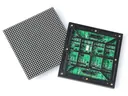
 Outdoor SMD Screens
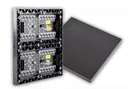 Indoor SMD Screens
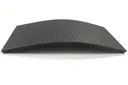 Flexible SMD Screens

SMD Screen Price in Pakistan: A Complete 2025 Buyer’s Guide
What shapes the cost of SMD screens in Pakistan: indoor vs outdoor, pixel pitch, refresh rate, cabinets, components, structure, controllers,…
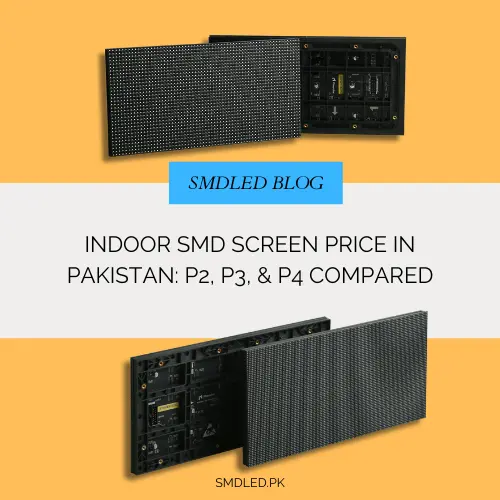
From offices in Blue Area Islamabad to retail centres in Gulberg Lahore, indoor video walls are becoming common in Pakistan. For first-time buyers, the terminology can be confusing. One of the most common questions we receive at SMD LED is how cost and clarity differ between pixel pitches. In other words, how does the Indoor SMD screen price in Pakistan vary between P2, P3 and P4?
This guide explains the technical differences, typical use cases and the factors that shape a quotation. We do not list prices here, because they depend on the specific product, specification, quantities and the time of purchase. For a current figure, ask for a written quotation.
“P” stands for pixel pitch: the distance in millimetres between the centre of one pixel and the centre of the next.
As a general rule, a lower P-value means more pixels per square metre, more detail at close range and usually a higher cost per square metre. A finer pixel pitch lets viewers stand closer without seeing individual pixels.
P2 has about 250,000 pixels per square metre. Other fine pitches, such as P1.8 or P2.5, are separate products with their own specifications. A P2 screen is not automatically “4K”: resolution depends on size. Native 4K (3840 × 2160 pixels) at a 2 mm pitch needs a screen about 7.68 m × 4.32 m, before rounding to whole cabinets. A smaller P2 screen has fewer pixels. For fine-pitch options, such as the BIA HDR 4K LED Video Wall, ask us for the exact pitch and datasheet.
Of the three pitches, P2 usually costs the most per square metre, because it needs more LEDs and driver ICs in the same area.
If your audience will be close to the screen, for example in a meeting room or small boutique, a fine pitch such as P2 helps avoid a grainy image. The right choice also depends on your content: small text needs a finer pitch than video.
P3 has about 111,111 pixels per square metre. It is widely used for wedding halls and events, balancing detail and cost: sharper than P4 and generally more affordable than P2.
When clients want a balance between budget and quality, P3 is often a good fit, particularly for larger screens viewed from a few metres away.
For a wedding stage where most guests sit well back from the screen, P3 often looks good, and the extra cost of P2 may bring little visible benefit. Check sightlines and content first: guests who come close to the stage, or fine text on screen, may still favour a finer pitch.
P4 has about 62,500 pixels per square metre. It is now an entry-level indoor option, suitable for large venues where the audience is further away.
P4 is generally the most economical of the three per square metre, which suits large video walls where size matters more than close-up detail.
If a screen is mounted high on a wall in a mall atrium and most viewers are far away, the difference between P4 and P3 may be small. Whether it is noticeable depends on the viewing distance, the content and how close people can get.
The main differences between the three pitches:
| Feature | P2 Indoor | P3 Indoor | P4 Indoor |
|---|---|---|---|
| Pixel Pitch | 2 mm | 3 mm | 4 mm |
| Pixel Density | ~250,000 pixels/m² | ~111,111 pixels/m² | ~62,500 pixels/m² |
| Typical Min. Viewing Dist. | ~2 m | ~3 m | ~4 m |
| Cabinet Type | Varies by product | Varies by product | Varies by product |
| Power Consumption | Depends on the product and brightness; compare datasheets | ||
| Relative Cost per m² | Higher | Middle | Lower |
Beyond pixel pitch, several other factors affect the quotation you receive.
Lower refresh rates are usually fine for the human eye. If the screen will be filmed, for example for wedding videos or broadcasts, a higher refresh rate reduces the risk of visible scan lines and flicker on camera. Results also depend on camera settings such as shutter speed. Higher refresh-rate driver ICs usually add to the cost.
The LED lamps used affect brightness, colour consistency and reliability. Ask the supplier which LED brand and driver ICs are used in the exact product quoted. Very cheap, unbranded components may lower the initial cost but can be less reliable.
A flat wall mount, a curved structure and a hanging installation all differ. Custom fabrication and structural engineering are usually quoted separately from the screen itself, and structures should be checked by a qualified engineer.
Suppose you want a video wall of about 3 m × 1.8 m (roughly 10 ft × 6 ft) in an office lobby. To compare options:
The cost per square metre usually rises as the pitch gets finer. Let the viewing distance and content decide: in a small lobby where people stand close, a finer pitch is usually worth considering; in a large atrium, P3 or P4 may be enough.
A video wall is a significant investment. At SMD LED, we can discuss your site, viewing distance and content, and recommend a suitable pitch.
Our products include the BIA Indoor SMD Screen Modules, our own brand, with local warranty support. Ask us for the datasheet and warranty terms of the product you are considering. Good electrical protection, designed by a qualified electrician, helps protect any screen from supply fluctuations.
The cost of an indoor SMD screen depends on pitch, size, specification and installation. P2 offers the most detail for close viewing, P3 is a versatile middle option, and P4 suits large screens viewed from further away.
Assess your venue size, viewing distances and content, and you can avoid both overspending on a pitch you don’t need and choosing one that is too coarse for close viewers.
For a current quotation, contact our team. You can also follow us on Facebook or visit our Products page.
1. How much does a small indoor SMD screen for a shop cost? It depends on the size, pitch (often P2.5 or P3 for shops), cabinet type, controller and installation. Contact us with your dimensions and viewing distance for a written quotation.
2. Can I use an indoor P4 screen outdoors to save money? No. Indoor screens are not designed to be waterproof and have much lower brightness than outdoor screens. Outdoors, an indoor screen risks water damage and electrical hazards, and will be hard to see in sunlight. Use an outdoor-rated product with a suitable IP rating (for example IP65 on the front).
3. Does an indoor SMD screen quotation include the video processor? It varies. Quotations often cover modules, cabinets, power supplies and receiving cards, with the sending card or video processor listed separately. Check each quotation’s scope.
4. How does the P-value affect power consumption? A finer pitch has more LEDs per square metre, but power also depends on the LED efficiency, driver design, brightness setting and content. Compare the average and maximum power figures on each product’s datasheet.
5. What is the lifespan of an indoor SMD screen? It depends on component quality, operating hours, brightness, cooling and maintenance, and different parts (LEDs, power supplies) age differently. Check the manufacturer’s rated lifetime and the warranty for the specific product.
Planning an indoor display? Visit our Contact Us page for a written quotation for your exact requirements.
What shapes the cost of SMD screens in Pakistan: indoor vs outdoor, pixel pitch, refresh rate, cabinets, components, structure, controllers,…
How to get approval for an outdoor SMD screen in Lahore: find the authority for your site, get owner consent,…

An ideas piece: which Lahore locations could suit digital displays, from Liberty Roundabout to MM Alam Road, and why heritage…